Underground Mining Cable Safety Standards Explained
Underground mining depends on reliable electrical systems to keep face equipment moving, protect crew lives, and ensure continuous power distribution. Heavy-duty underground mining cable designs must withstand severe mechanical stress, crushing forces, continuous flexural fatigue, high humidity, and aggressive rock abrasion that would instantly destroy standard industrial wiring. In the United States, mine operators face strict Mine Safety and Health Administration (MSHA) requirements under 30 CFR Part 75 covering cable construction, grounding integrity, regular inspection routines, and circuit protection. Choosing certified cable is only the first step; safe installation, clean routing, qualified splices, and regular maintenance keep the power flowing safely underground.
Key Takeaways
- Comply with 30 CFR Part 75: MSHA mandates strict construction, flame-resistance, and continuous grounding checks for trailing cables and high-voltage underground power circuits.
- Prevent Mechanical Damage: Hang cables properly to avoid rock pinches, severe jacket abrasion, equipment run-overs, and continuous standing water exposure.
- Enforce Proper Splicing: Complete all trailing cable splices using MSHA-accepted materials to maintain insulation shield continuity and outer jacket flame resistance.
- Maintain Ground-Check Systems: Monitor grounding conductor continuity continuously to clear dangerous fault currents before equipment frames become energized.
- Partner with Mine Specialists: Work with experienced suppliers like Becker Wholesale Mine Supply to source fully compliant power distribution equipment built for demanding underground environments.
What Regulations Govern Your Underground Power Setup?
Federal MSHA safety standards mandate strict construction and operating rules for electrical cables based on mine type, operating voltage, and equipment mobility. Under 30 CFR Part 75, federal inspectors evaluate trailing cables, grounding paths, low-voltage lines, and high-voltage distribution networks to eliminate electrical shock and mine fire risks.
The reality on the ground is that cable selection cannot be handled as an isolated purchasing decision. Mine electrical superintendents must verify how every cable integrates into the complete circuit protection scheme. Key sections of 30 CFR Part 75 regulate your power system:
- Subpart G (Trailing Cables): Regulates physical construction, conductor sizing, outer jacket toughness, and continuous ground-check monitoring for mobile continuous miners and shuttle cars.
- Subpart H (Grounding): Requires low-resistance metallic grounding paths to safely carry fault current directly back to protective circuit breakers.
- Subpart I (High-Voltage Distribution): Sets strict shielding, coupler, and clearance standards for high-voltage power center feeds.
- Subpart J (Low- and Medium-Voltage Circuits): Dictates overland circuit breaker settings, disconnect switches, and overload protection limits.
For instance, 30 CFR 75.906 mandates effective continuity protection on trailing cables using ground-check conductors or approved solid-state monitoring alternatives.
How Do You Choose the Right Cable for Hard Underground Use?
Matching electrical cables to specific underground applications requires evaluating operating voltage, mechanical tension, ambient moisture, flex fatigue, and MSHA flame-resistance acceptance. Installing an improperly rated cable creates severe shock hazards, excessive voltage drops, premature insulation breakdown, and costly operational downtime.
Conditions vary dramatically between fresh air intake haulage roads and damp, highly stressed working faces. Before deploying an underground mining cable to power active machinery, safety teams must review nine key factors:
- Required Voltage Rating: Verify phase-to-phase and phase-to-ground operating limits.
- Equipment Mobility: Distinguish between stationary power center feeds and high-flex continuous miner trailing cables.
- Physical Cable Length: Calculate conductor resistance to limit excessive end-of-line voltage drops.
- Environmental Exposure: Identify constant standing water, acidic mine drainage, or ambient heat zones.
- Mechanical Stress Levels: Account for severe pulling tension, frequent reeving, and crushing risks.
- Grounding Configuration: Confirm ground conductor sizing and ground-check wire inclusion.
- MSHA Acceptance: Ensure outer jackets feature clear flame-resistant approval markings.
- Manufacturer Limits: Follow minimum bend radius and maximum tension guidelines.
- Site Procedures: Align cable specs with established mine electrical safety plans.
Why Is Flame Resistance Critical for Fire Prevention Below Ground?
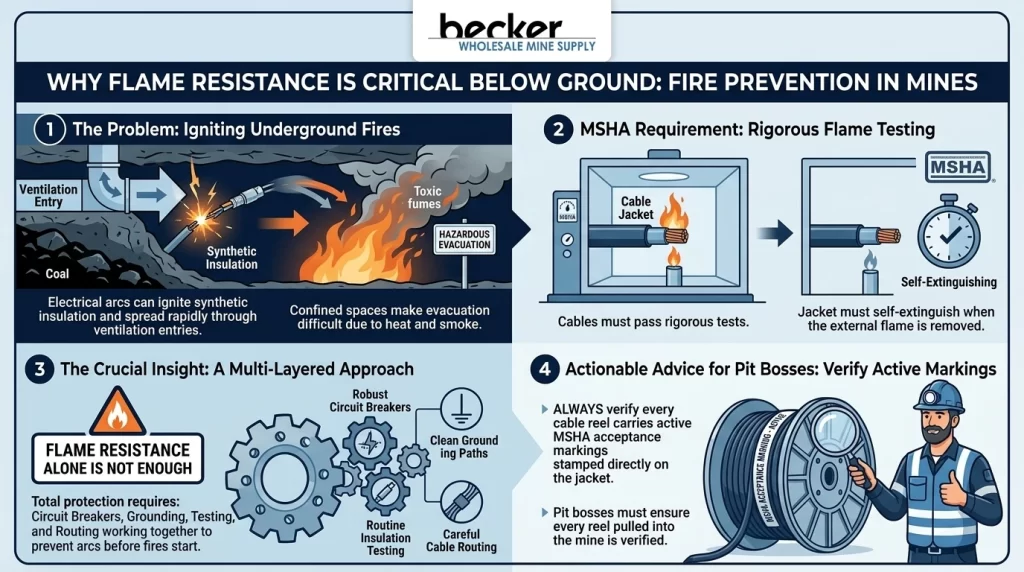
Flame-resistant cable jackets prevent electrical arcs from igniting synthetic insulation materials and spreading hazardous fires through underground mine ventilation entries. Fire safety requires extreme discipline because heat, toxic fumes, and smoke spread rapidly through confined coal seams, making mine evacuation hazardous.
MSHA requires trailing cables and power feeds to pass rigorous flame tests, proving the jacket self-extinguishes once an external flame source is removed. Here is the part most pit bosses know firsthand: flame resistance alone will not prevent electrical fires if system protection fails. Robust circuit breakers, clean grounding paths, routine insulation testing, and careful routing work together to stop arcs before fires start. Always verify that every cable reel pulled into your mine carries active MSHA acceptance markings stamped directly on the outer jacket.
GET IN TOUCH
In a hurry? Call us at +1-724-515-4993
Simple 4-Step Plan for Protecting Underground Power Lines
- Survey Cable Routes Before Hanging
- Inspect entryways for heavy mobile equipment haulage routes and active roof falls.
- Identify water accumulation spots to elevate lines away from acidic mud.
- Install Heavy-Duty Cable Hangers
- Space non-conductive hangers closely to eliminate sag points where shuttle cars can snag lines.
- Maintain generous bending radiuses around timber sets and coal ribs to protect inner shielding.
- Build Substantial Crossover Bridges
- Construct heavy steel or rubber ramp bridges wherever rubber-tired haul trucks must cross cables.
- Clear coal rib pinch points so machinery frames cannot pin cables against rock walls.
- Perform Daily Visual and Coupler Checks
- Examine high-voltage couplers for dirt, moisture ingress, or damaged pin contacts.
- Remove cables immediately if outer jackets show deep cuts, crushed spots, or exposed inner wire.
Safety Focus Areas for Crew Protection
Electrical Grounding and Fault Protection
Grounding wires provide a low-resistance return path that draws short-circuit currents directly to trip protective relays. Ground-check monitoring systems continually send low-voltage pilot signals through the ground-check conductor to verify the ground wire remains intact. If a shuttle car pulls its trailing cable too tight and snaps the ground wire, the ground-check monitor instantly trips the power center breaker, de-energizing the machine frame before a worker touches it.
Physical Protection and Routing Management
Even heavy-duty neoprene jackets fail when continuous miner tracks roll over them. Keep cables suspended off rib floors using heavy-duty insulated hangers. Avoid sharp rock corners, manage reel tension carefully during machine movement, and route power lines completely away from standing water pools to prevent premature jacket breakdown.
Quick Comparison: Temporary Cable Repairs vs. Permanent Replacement
| Feature | Field Cable Splice | Full Cable Replacement |
| Primary Goal | Restore power safely following localized jacket or conductor damage. | Replaces worn-out or heavily damaged cables. |
| Repair Materials | MSHA-accepted splice kits with cold-shrink or heat-shrink sleeves. | Factory-assembled cable reel with molded high-voltage couplers. |
| Skill Requirement | Completed exclusively by certified mine electricians following strict steps. | Installed by general mine maintenance crews under supervisor oversight. |
| Mechanical Strength | Restores partial flexibility but creates localized rigid sections. | Delivers full original tensile strength and uniform flex resistance. |
| Long-Term Suitability | Ideal for minor repairs on active trailing cables. | Best choice when multiple splices compromise flex life or safety. |
Important Cable Terminology for Mine Electricians
- Trailing Cable: Heavy-duty flex cable supplying power to mobile equipment like shuttle cars, roof bolters, and continuous miners.
- Ground-Check Conductor: A insulated wire used with monitoring relays to check ground circuit continuity continuously.
- Flame-Resistant Jacket: Outer vulcanized rubber or polymer casing engineered to self-extinguish during flame exposure.
- Phase Shielding: Metallic copper braid wrapped around individual power conductors to drain capacitive charge and equalize electrical stress.
- Cable Coupler: Heavy-duty, explosion-proof pin-and-socket connector designed to join high-voltage distribution cables safely.
Pro Tip for Mine Safety Managers
Document splice locations along active trailing cables. While MSHA permits properly executed splices on trailing cables, accumulating multiple splices within a short span weakens physical strength and increases electrical resistance. Establish an internal shop rule: when a trailing cable section accumulates more than four splices within 300 feet, pull the reel to an underground shop for vulcanized re-jacket repairs or full section replacement.
How Becker Wholesale Mine Supply Keeps Your Operation Powered
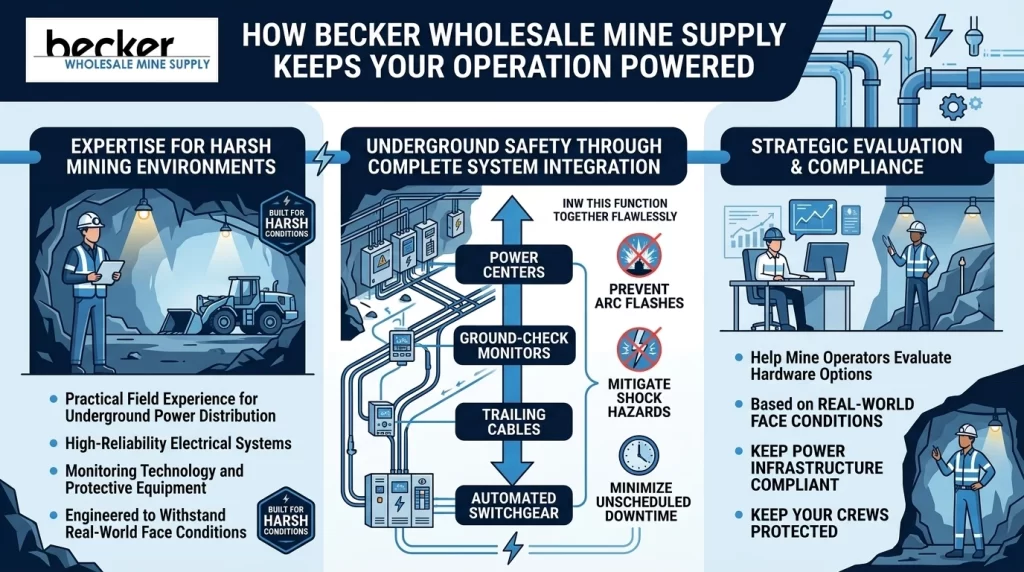
Becker Wholesale Mine Supply brings practical field experience to underground power distribution, offering high-reliability electrical systems, monitoring technology, and protective equipment engineered for harsh mining conditions. Underground safety relies on complete system integration. Power centers, ground-check monitors, trailing cables, and automated switchgear must function together flawlessly to prevent arc flashes, shock hazards, and unscheduled downtime. Becker Wholesale Mine Supply helps mine operators evaluate hardware options based on real-world face conditions, keeping your power infrastructure compliant and your crews protected.
GET IN TOUCH
In a hurry? Call us at +1-724-515-4993
Upgrade Your Underground Electrical Safety Infrastructure Today
Protecting crews and maintaining steady production requires high-performance electrical hardware built for severe underground conditions. Becker Wholesale Mine Supply provides MSHA-grade distribution centers, continuous monitoring systems, and rugged power hardware tailored to your specific mine layout. Ready to upgrade your underground power distribution system? Connect with our technical team today to review your electrical infrastructure needs and explore our complete line of mining-grade equipment.
Frequently Asked Questions
Q: What makes an underground mining cable different from industrial power wire?
A: An underground mining cable features heavy-duty stranded copper conductors, extra-flexible insulation, metallic phase shielding, and a tough, flame-resistant synthetic rubber jacket designed to handle continuous flexure, crushing, moisture, and rock abrasion.
Q: How does MSHA regulate cable safety in coal mines?
A: MSHA enforces strict electrical rules under 30 CFR Part 75, mandating flame-resistant jackets, continuous ground-check monitoring circuits, approved splicing methods, regular visual inspections, and dedicated circuit breaker protection.
Q: Why are ground-check monitoring systems required on mobile equipment?
A: Ground-check circuits constantly monitor the continuity of the equipment grounding wire. If a cable snaps or loses its ground connection, the system instantly trips the circuit breaker, preventing dangerous shock voltages on the machine frame.
Q: Can you splice high-voltage trailing cables underground?
A: Yes, but splices must be made by qualified personnel using MSHA-accepted repair methods and materials that fully restore conductor continuity, electrical shielding, insulation, and flame-resistant outer jacket protection.
Q: What are the most common causes of underground cable failures?
A: Physical damage tops the list: running over cables with equipment tires, crushing lines against coal ribs, excessive tension snapping internal conductors, sharp rock cuts, and continuous exposure to acidic mine water.
Products That We Offer
- VHF Leaky Feeder System
- UHF Leaky Feeder System
- SMARTSENSE®FIXED MONITOR
- RNG-500VHF Leaky Feeder Cable
- UHF Low Loss Leaky Feeder Cable
- Kenwood NX-203/303 Radios
Take control of your mining communication systems today! With Becker Wholesale Mine Supply, the leading manufacturer in the USA. Contact us now and revolutionize your mining communication systems!