What Makes an Industrial Two Way Radio Reliable?

In mining shafts, active construction zones, rail yards, and offshore oil rigs, comms cannot fail when conditions turn harsh. A commercial-grade industrial two way radio proves its worth by delivering crystal-clear transmissions despite choking dust, driving rain, heavy machinery rumble, physical drops, and subterranean rock barriers. Becker Wholesale Mine Supply builds complete underground comms ecosystems to protect field crews across the United States. Real field reliability is about keeping your crew connected when conditions get tough.
Key Takeaways
- Build Quality Protection: High-impact polycarbonate housings and IP-rated seals shield sensitive internal circuitry from sudden drops, water jets, and heavy airborne particulates.
- Acoustic Noise Reduction: Advanced digital signal filtering isolates human voices from the roar of heavy diesel haul trucks and underground ventilation fans.
- Subterranean Infrastructure Support: Radiating leaky feeder cables serve as continuous in-tunnel antennas where standard line-of-sight RF signals fail.
- Shift-Length Power Delivery: High-capacity lithium-ion battery packs maintain steady output across extended 12-hour shifts without mid-day voltage drops.
Why Is Rugged Hardware Essential for Harsh Work Sites?
A dependable radio must withstand constant punishment, high vibration, and severe impacts without losing internal calibration or shattering its casing. Industrial sites destroy consumer-grade electronics in days. Field-tested gear keeps workers linked to supervisors during unexpected equipment jams or emergency roll calls.
The physical reality on mine haul roads and steel erection sites is brutal. Equipment gets tossed into truck beds, banged against steel beams, and exposed to damp mine air filled with corrosive dust.
- Force-resistant outer shells absorb impact energy before it snaps delicate circuit boards.
- Precision environmental seals keep high-pressure water and fine silica dust out of sensitive electronics.
- Heavy-duty tactile knobs let operators change channels cleanly while wearing bulky leather work gloves.
- Streamlined casings prevent gear from snagging on tight crawlspaces or structural harness webbing.
- Industrial circuit boards handle constant chassis vibration from heavy earth-moving equipment.
Becker Wholesale Mine Supply stocks heavy-duty handheld handsets, Kenwood NX-203/303 units, and specialized leaky feeder hardware built specifically for tough industrial environments.
How Do Audio Quality, Signal Range, and Battery Life Drive Safety?
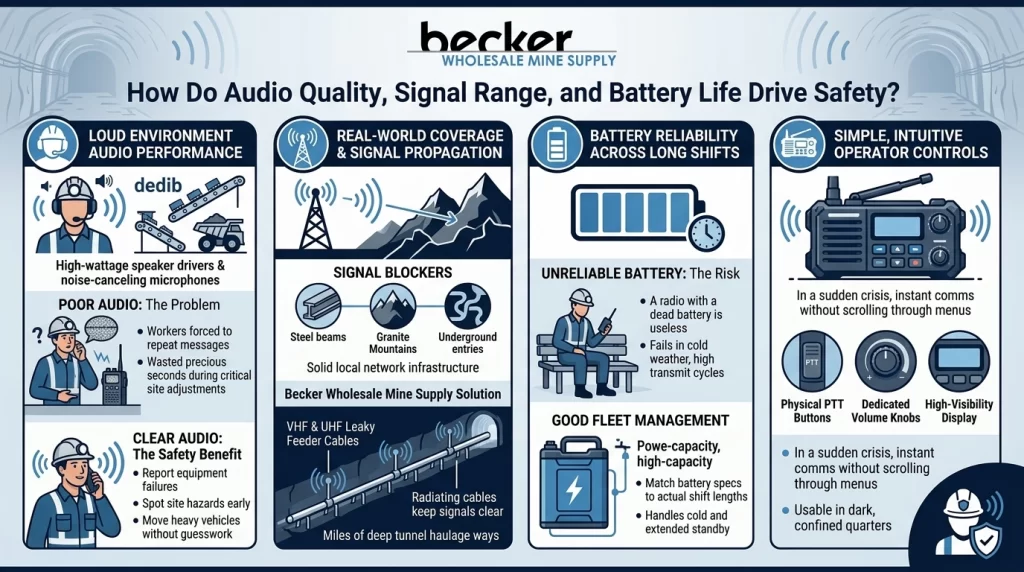
High-noise work environments require specialized high-wattage speaker drivers and noise-canceling microphones to ensure every voice transmission is instantly understood. Real-world coverage depends on solid local network infrastructure rather than unrealistic factory range ratings.
Loud Environment Audio Performance
Conveyors, rock drills, and haul truck engines generate high ambient decibels. Poor speakers force workers to repeat messages, wasting precious seconds during critical site adjustments. Clear audio helps crews report equipment failures, spot site hazards early, and move heavy vehicles without guesswork.
Real-World Coverage & Signal Propagation
Steel beams, granite mountains, and winding underground entries block standard radio signals. Becker Wholesale Mine Supply deploys specialized VHF and UHF leaky feeder cable networks through subterranean entries. These radiating cables act as long, continuous antennas to keep signals clear along miles of deep tunnel haulage ways.
Battery Reliability Across Long Shifts
A radio with a dead battery is useless to a worker on a remote bench. High-capacity power packs must handle cold weather, long transmit cycles, and extended standby periods without failing. Good fleet management matches battery specs to actual shift lengths.
Simple, Intuitive Operator Controls
In a sudden crisis, a worker cannot waste time scrolling through digital menus. Physical push-to-talk (PTT) buttons, dedicated volume knobs, and high-visibility displays allow instant comms even in dark, confined quarters.
GET IN TOUCH
In a hurry? Call us at +1-724-515-4993
How Should You Plan a Site-Wide Communications Setup?
- Conduct a Thorough Site Survey
- Map all high-density concrete structures, deep rock entries, elevation drops, and metal equipment barriers.
- Identify extreme ambient noise pockets around rock crushers, ventilation drives, and heavy diesel equipment.
- Select the Right Frequency Band and Infrastructure
- Deploy VHF setups for broad open-pit areas or UHF hardware for dense structural environments.
- Run low-loss leaky feeder cable along subterranean entries to guarantee complete signal coverage.
- Deploy Emergency Monitoring and System Diagnostics
- Integrate real-time diagnostic systems to detect cable breaks or signal drops before shifts begin.
- Add personnel tracking and gas monitoring systems into the main radio backbone for complete site awareness.
Which Setup Fits Your Operations Best?
| System Parameter | Open-Air Surface Mining & Rail | Underground Mine Entries & Tunnels | Heavy Structural Industrial Worksites |
| Primary Technology | High-Power VHF Systems | VHF/UHF Leaky Feeder Cable | High-Density UHF Networks |
| Signal Behavior | Long-range line of sight | Continuous guided RF radiation | Strong penetration through steel/concrete |
| Primary Obstacle | Rolling hills & long distances | Solid rock walls & tight turns | Dense metal beams & electrical noise |
| Hardware Focus | High-wattage output & weather seals | Flexible radiating cable & repeaters | Multi-channel noise suppression |
Key Terms for Jobsite Communications
- VHF (Very High Frequency): Lower frequency signals that travel long distances over open, flat outdoor terrain.
- UHF (Ultra High Frequency): Higher frequency signals that penetrate steel structures, thick walls, and crowded indoor sites.
- Leaky Feeder Cable: A specialized coaxial cable with targeted gaps in its shielding that leaks RF signals along its length, acting as an extended antenna in tunnels.
- RNG-500 Cable: A durable VHF leaky feeder cable designed to withstand tough underground mining environments.
- System Diagnostics: Active monitoring tools that check cable continuity, power levels, and signal health across subterranean networks.
Practical Tip from the Field
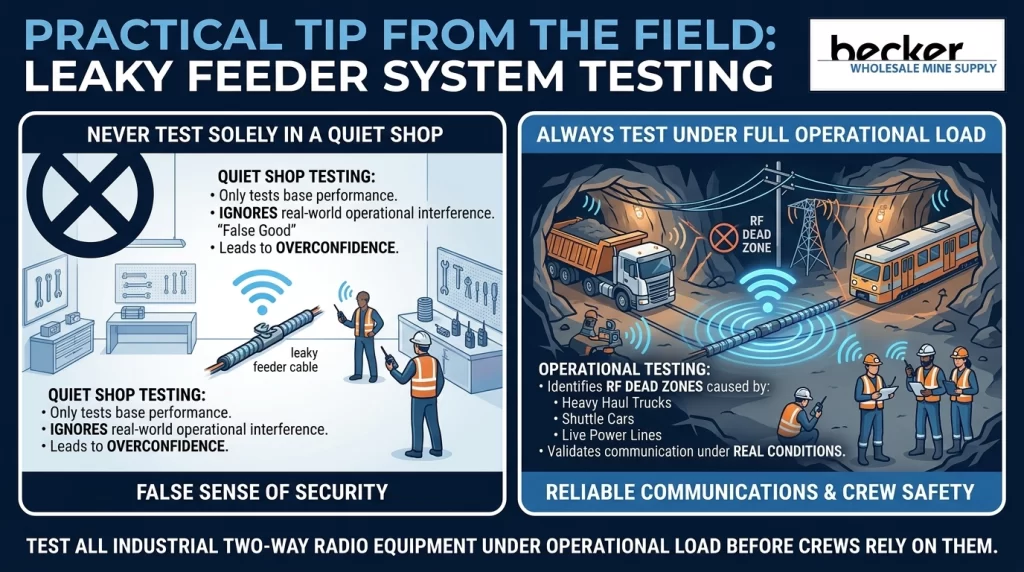
Never test leaky feeder systems solely in a quiet shop. Signal performance changes significantly when heavy haul trucks, underground shuttle cars, and live power lines enter the entries. Always test your industrial two way radio equipment under full operational load to identify RF dead zones before your crews rely on them.
GET IN TOUCH
In a hurry? Call us at +1-724-515-4993
Upgrading Your Worksites with Becker Wholesale Mine Supply
Since 2005, Greensburg, Pennsylvania-based Becker Wholesale Mine Supply has designed custom industrial communication, tracking, and gas monitoring systems across the USA. From tough handheld radios to custom leaky feeder networks, Becker builds reliable comms solutions tailored to your jobsite.
Upgrade your jobsite communications today. Contact Becker Wholesale Mine Supply online or call their engineering team directly to build a custom industrial two way radio system designed for your operations.
Frequently Asked Questions
Q: What is an industrial two-way radio?
A: An industrial two-way radio is a heavy-duty communication device built with high-impact housing, weather sealing, noise-canceling electronics, and strong internal amplifiers. It handles extreme dust, water, vibration, and drops on tough jobsites.
Q: Why are industrial radios more reliable than standard consumer radios?
A: Industrial radios use reinforced polycarbonate frames, industrial-grade internal components, high-wattage audio drivers, and commercial frequency bands. They maintain strong performance through extreme temperatures, long shifts, and hard drops.
Q: Should we use VHF or UHF for our operations?
A: VHF works best for long, open outdoor spaces like surface mines or rail yards. UHF excels at penetrating dense steel beams, concrete structures, and indoor industrial facilities. Becker Wholesale Mine Supply provides both options.
Q: How does an underground leaky feeder radio system work?
A: Leaky feeder systems use a specialized coaxial cable with small openings in its outer shield running through tunnel networks. The cable radiates RF signals continuously, acting as a long antenna that eliminates underground dead zones.
Q: What factors determine how long a radio battery will last?
A: Battery life depends on battery milliamp capacity, ambient temperatures, transmit vs. standby time, and display brightness settings. Industrial-grade lithium-ion packs are sized to power radios reliably across full 12-hour shifts.
Products That We Offer
- VHF Leaky Feeder System
- UHF Leaky Feeder System
- SMARTSENSE®FIXED MONITOR
- RNG-500VHF Leaky Feeder Cable
- UHF Low Loss Leaky Feeder Cable
- Kenwood NX-203/303 Radios
Take control of your mining communication systems today! With Becker Wholesale Mine Supply, the leading manufacturer in the USA. Contact us now and revolutionize your mining communication systems!