Reliable Gas Sensor Detector Systems for Mining
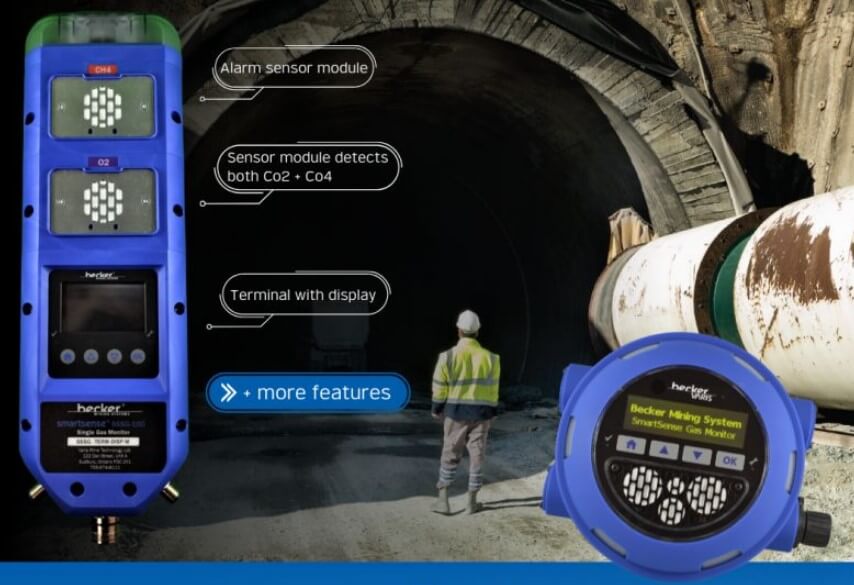
Mining atmospheres can change quickly. Ventilation shifts, geological conditions, blasting, diesel equipment, and active mining processes can introduce hazardous gases or affect oxygen levels. A reliable gas sensor detector gives mine personnel an earlier indication that atmospheric conditions are moving outside acceptable limits.
At Becker Wholesale Mine Supply, we provide gas monitoring solutions designed around the demanding conditions found in underground and surface mining operations. Our approach goes beyond simply detecting a gas. An effective monitoring system must identify the right hazards, provide useful alarms, withstand the mining environment, and communicate information to the people who need it.
Gas detection is also part of a larger mine-safety strategy. Depending on the operation, monitoring may involve portable instruments, fixed detectors, machine-mounted sensors, alarm systems, data logging, communications, and established procedures for responding when conditions change.
Key Takeaways
- A gas sensor detector measures hazardous gases or atmospheric conditions and provides warnings when preset thresholds are reached.
- Methane, carbon monoxide, oxygen levels, and other gases may require monitoring depending on the mine and its specific hazards.
- Portable and fixed detectors serve different purposes and can work together as layers of protection.
- Sensor technology should be selected according to the target gas, operating environment, maintenance requirements, and monitoring objective.
- MSHA requirements vary according to the type of mine, equipment, location, and application.
- Calibration, detector placement, alarm communication, and maintenance are just as important as the sensor itself.
What Is a Gas Sensor Detector?
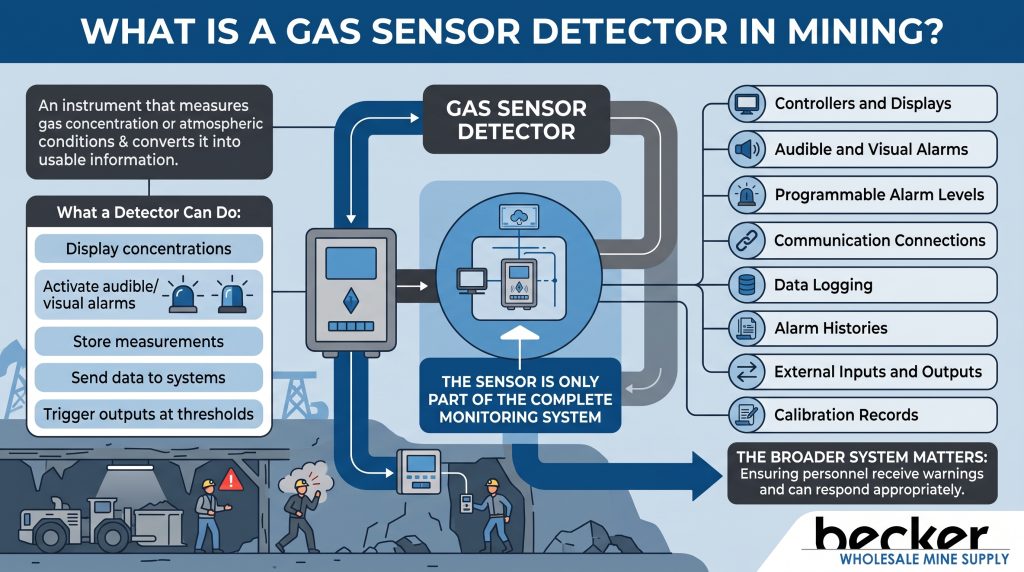
A gas sensor detector is an instrument that measures the presence or concentration of a gas or atmospheric condition and converts that measurement into information that workers or monitoring systems can use.
Depending on its design, the detector may display a concentration, activate an audible or visual alarm, store measurements, send data to another system, or trigger an output when a specified threshold is reached.
The sensor itself is only part of the complete monitoring system.
A mining gas detection installation may also include:
- Controllers and displays
- Audible and visual alarms
- Programmable alarm levels
- Communication connections
- Data logging
- Alarm histories
- External inputs and outputs
- Calibration records
This broader system matters because detecting a dangerous condition is only useful when mine personnel can receive the warning and respond appropriately.
GET IN TOUCH
In a hurry? Call us at +1-724-515-4993
Why Are Gas Sensor Detector Systems Important in Mining?
Gas sensor detector systems provide an early warning of atmospheric hazards that workers may not otherwise be able to recognize.
Many hazardous mining gases are invisible, and some cannot reliably be identified by smell. Conditions can also change as work progresses or ventilation patterns shift. Continuous or regularly performed atmospheric monitoring gives mine personnel objective information instead of relying on human senses.
Gas monitoring can help mines identify conditions involving:
Methane
Methane, or CH₄, is a combustible gas and a significant concern in certain underground mining environments. When methane reaches dangerous concentrations, ignition can create a serious explosion hazard.
Monitoring allows personnel and automated systems to identify rising concentrations before conditions become more dangerous.
Carbon Monoxide
Carbon monoxide, or CO, is colorless and odorless. It can be produced by combustion and may also provide an indication of underground fire conditions.
Because people cannot reliably detect CO without instrumentation, sensors provide an important layer of atmospheric monitoring.
Oxygen
Gas monitors can also identify oxygen-deficient or otherwise abnormal atmospheres.
Oxygen monitoring is particularly important when personnel may enter enclosed, poorly ventilated, or changing underground environments.
Hydrogen Sulfide
Hydrogen sulfide, or H₂S, may be present in some mining environments depending on geology, water conditions, and other site-specific factors.
Because exposure can be dangerous, mines with an identified H₂S hazard may need suitable sensing equipment incorporated into their monitoring strategy.
Other Gases
Depending on the mining process and site conditions, operators may also evaluate carbon dioxide, nitrogen dioxide, sulfur dioxide, or other gases.
There is no universal combination of sensors suitable for every mine. The right system starts by identifying the actual atmospheric hazards associated with the operation.
What Does MSHA Require for Mining Gas Detection?
MSHA gas-detection requirements depend on the type of mine and the particular application, so operators should select monitoring equipment based on the regulations that apply to their operation rather than assuming one detector configuration meets every requirement.
For example, federal underground coal mine rules require operators to provide an MSHA-approved handheld multi-gas detector capable of measuring methane, oxygen, and carbon monoxide to each group of underground miners and to individuals who work alone.
MSHA regulations also contain requirements for atmospheric monitoring systems, including testing and calibration provisions for certain carbon monoxide, methane, smoke, and oxygen sensors.
Certain mining applications have additional methane-monitor requirements. Regulations covering specified underground metal and nonmetal mine classifications, for example, include requirements for monitors on particular mining equipment and establish methane warning or equipment-shutdown levels.
The practical takeaway is simple: gas detection should be designed around the mine, its hazards, applicable regulations, equipment locations, and operating procedures.
How Do Gas Sensor Technologies Work?
Different gases require different sensing methods. Choosing a detector should therefore begin with the target hazard rather than simply comparing the number of gases listed on a specification sheet.
Electrochemical Sensors
Electrochemical sensors are commonly used for toxic gases such as carbon monoxide and hydrogen sulfide.
The target gas interacts with the sensor and creates an electrical response related to its concentration.
These sensors can be well suited to toxic-gas monitoring, but their performance still depends on factors such as calibration, temperature, humidity, sensor condition, and possible interfering gases.
Infrared Sensors
Infrared gas sensors measure how specific gases absorb infrared energy.
This technology may be used for gases such as methane or carbon dioxide, depending on the instrument design. Because the measurement does not rely on burning the target gas at the sensing element, infrared technology can offer practical advantages in appropriate applications.
However, no sensing technology should be selected solely because it is described as more advanced. The gas being measured, operating range, environmental conditions, equipment approval requirements, and maintenance plan all matter.
Catalytic Sensors
Catalytic sensors are widely associated with combustible-gas detection.
When combustible gas reacts on the sensing element, the resulting change can be used to estimate gas concentration.
These sensors have operating limitations, including dependence on sufficient oxygen for the catalytic reaction. Operators therefore need to understand both what a sensor measures and the conditions under which it can produce dependable readings.
What Makes a Reliable Mining Gas Detector?
A reliable detector is not simply the instrument with the longest feature list. It is the one that performs consistently under the conditions in which it will actually operate.
When evaluating a gas sensor detector, consider the following factors.
The Correct Target Gases
Start by determining which gases are reasonably expected in each monitoring area.
Installing a four-gas detector provides little benefit if the selected four sensors do not match the hazards at that location.
Environmental Durability
Mining equipment may be exposed to:
- Dust
- Water and moisture
- Vibration
- Temperature changes
- Impact
- Harsh underground conditions
Detector housing, connectors, electronics, and sensor performance must be suitable for that environment.
The SMARTSENSE® SSFM-100, for example, is published with an IP67 rating and a stated operating temperature range of -20°C to +40°C.
Clear Alarms
A detector must communicate abnormal conditions clearly enough for personnel to recognize that action may be required.
Depending on the application, alerts may include audible alarms, visual indicators, remote notifications, control-system outputs, or combinations of these methods.
Calibration and Maintenance
Sensors drift, age, become contaminated, or otherwise change over time. Calibration and functional testing therefore remain essential.
MSHA rules for certain atmospheric monitoring systems specifically require periodic testing and calibration of applicable sensors, reinforcing why calibration should be treated as part of the monitoring system rather than an afterthought.
Connectivity
A local alarm helps workers near the detector. Connected monitoring can provide information to personnel elsewhere in the mine.
The SMARTSENSE® Fixed Monitor includes RS485 Modbus connectivity along with external digital and analog inputs and programmable outputs, allowing the monitor to exchange information with compatible systems.
Integrating Gas Detection With Mine Communication
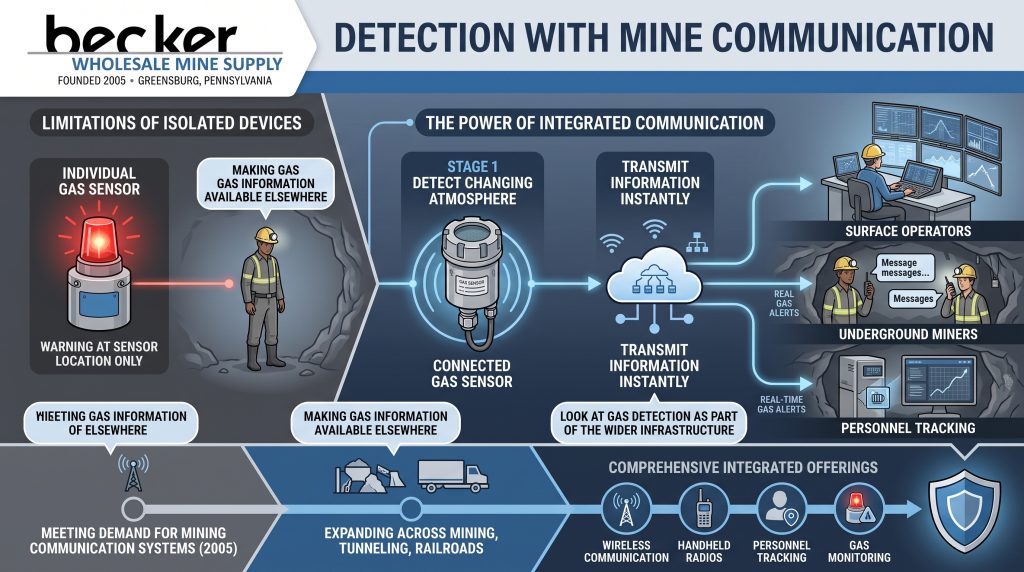
Detecting a changing atmosphere is the first step. Getting that information to the right people is the next.
A fixed monitor may activate a warning at the sensor location, but mines can also use connected systems to make gas information available elsewhere.
This is an area where our broader experience at Becker Wholesale Mine Supply is relevant.
We were founded in Greensburg, Pennsylvania, in 2005 to meet demand for mining communication systems. As our work expanded across underground mining, surface mining, railroads, and tunneling, our product offerings grew to include wireless communication, handheld radios, personnel tracking, and gas monitoring.
That combination allows operators to look at gas detection as part of the wider mine information and communication infrastructure instead of treating every detector as an isolated device.
GET IN TOUCH
In a hurry? Call us at +1-724-515-4993
Choosing a Gas Sensor Detector for Your Mine
The best gas sensor detector is the one selected around the hazards and operating conditions of the actual mine.
Before specifying equipment, determine:
- Which gases need to be monitored.
- Where those gases may originate or accumulate.
- Whether monitoring should be portable, fixed, machine-mounted, or layered.
- Which regulatory and equipment-approval requirements apply.
- How alarms will reach workers and control personnel.
- How detectors will be inspected, tested, and calibrated.
- Whether gas readings need to be logged or integrated with other mine systems.
This process produces a more useful monitoring strategy than choosing equipment solely by sensor count or headline specifications.
Reliable Gas Monitoring From Becker Wholesale Mine Supply
At Becker Wholesale Mine Supply, we provide mining gas monitoring alongside communication, tracking, and other technologies designed for demanding mining environments. Our SMARTSENSE® Fixed Monitor offers configurable multi-gas monitoring with up to four integrated gas sensors, programmable alarm set points, calibration records, alarm history, data logging, and system connectivity.
More importantly, we understand that equipment needs to fit the operation around it.
Whether you are reviewing existing monitoring equipment, expanding fixed gas detection, or considering how gas alarms can work with the rest of your mine infrastructure, our team can help you evaluate options based on your site’s requirements.
Contact Becker Wholesale Mine Supply to discuss reliable gas sensor detector solutions for your mining operation.
Frequently Asked Questions
Q: What does a gas sensor detector do in a mine?
A: A gas sensor detector measures specific gases or atmospheric conditions and provides readings or alarms when concentrations reach defined levels. Depending on the system, measurements can also be logged or communicated to other mine equipment.
Q: Which gases should mines monitor?
A: The gases depend on the operation and its hazards. Methane, carbon monoxide, oxygen, hydrogen sulfide, carbon dioxide, and nitrogen dioxide are among the gases that may be relevant in mining environments. A site-specific hazard assessment and applicable regulations should guide the final selection.
Q: Are portable or fixed gas detectors better for mining?
A: Neither is universally better. Portable detectors move with workers and can be used for personal or spot monitoring, while fixed detectors provide continuous monitoring at selected locations. Many operations benefit from combining both approaches.
Q: Does MSHA require multi-gas detectors?
A: Specific MSHA rules apply according to the mine and application. In underground coal mines, operators must provide an MSHA-approved handheld detector capable of measuring methane, oxygen, and carbon monoxide to each group of underground miners and to each miner working alone.
Q: How often should a mining gas detector be calibrated?
A: Calibration frequency depends on applicable regulations, manufacturer instructions, sensor type, operating conditions, and the monitoring application. Certain MSHA atmospheric-monitoring provisions specify testing and calibration intervals, including calibration at least once every 31 days for specified sensors used under those provisions.
Q: Can one detector monitor several gases?
A: Yes. Multi-gas systems can combine several sensors in one monitor. Becker’s SMARTSENSE® SSFM-100 supports up to four integrated gas sensors in a single unit.
Products That We Offer
- VHF Leaky Feeder System
- UHF Leaky Feeder System
- SMARTSENSE®FIXED MONITOR
- RNG-500VHF Leaky Feeder Cable
- UHF Low Loss Leaky Feeder Cable
- Kenwood NX-203/303 Radios
Take control of your mining communication systems today! With Becker Wholesale Mine Supply, the leading manufacturer in the USA. Contact us now and revolutionize your mining communication systems!