Tunnel Radio Leaky Feeder Systems for Mine Safety
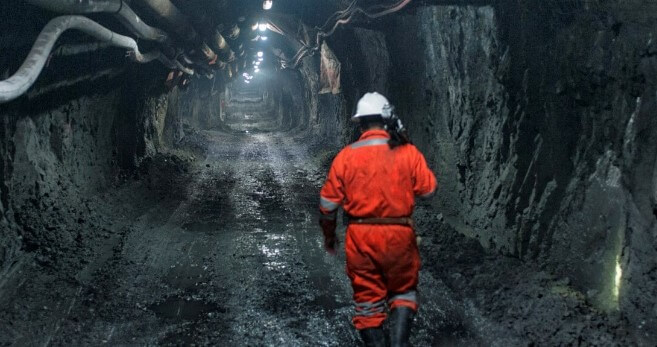
Reliable communication underground is harder than it looks. Rock, changing tunnel geometry, equipment, distance, and branching entries can all interfere with ordinary radio coverage. A radio that works clearly near the portal may become unreliable once a crew moves deeper underground or around several turns. A tunnel radio leaky feeder system addresses that problem by extending radio coverage along the path workers actually travel. Instead of depending on a single antenna to send a signal through rock, the system uses radiating coaxial cable as a distributed antenna throughout the mine or tunnel.
At Becker Wholesale Mine Supply, we provide underground communication systems designed for mining and tunneling environments where dependable voice communication is tied directly to safe, coordinated operations. Our Smartcom® leaky feeder options include VHF and UHF platforms with voice, data, gain-control, diagnostic, and upgrade capabilities for different underground requirements.
Key Takeaways
- A tunnel radio leaky feeder uses radiating coaxial cable to create radio coverage along underground haulages, entries, declines, and other cable routes.
- Amplifiers compensate for signal loss over distance, but spacing should be based on the cable, equipment, branches, frequency band, and actual system design rather than one universal distance.
- Reliable mine communication depends on more than the cable. Power supplies, splitters, terminations, amplifiers, base equipment, radios, installation quality, and maintenance all affect coverage.
- Leaky feeder networks can support more than voice communication, including data, remote diagnostics, and certain tracking or telemetry applications when the system is configured for them.
- Mine communication and tracking requirements can differ by mine type and jurisdiction. In U.S. underground coal mining, post-accident communication and personnel tracking are specifically addressed under the MINER Act and associated MSHA requirements.
What Is a Tunnel Radio Leaky Feeder System?
A tunnel radio leaky feeder system is an underground communication network that uses specially designed coaxial cable to transmit and receive radio-frequency signals along the cable route.
Unlike conventional coaxial cable, which is designed to keep RF energy contained, leaky feeder cable has openings in its outer conductor. These openings allow radio energy to radiate from the cable and allow signals from nearby portable radios to enter it.
The result is similar to placing a long antenna through the underground workings.
NIOSH describes a leaky feeder cable as a distributed antenna capable of transmitting and receiving signals along its length. The cable also transports the RF signal farther through the mine than a handheld radio could normally communicate through underground openings on its own.
That distinction matters underground. A conventional handheld radio may communicate adequately over a clear section of entry but lose contact as distance increases or the miner moves around corners, crosscuts, equipment, or changes in elevation.
A properly designed leaky feeder system moves the communication backbone closer to the people using the radios.
How Does a Tunnel Radio Leaky Feeder System Work?
A leaky feeder system works by carrying RF signals through radiating coaxial cable while allowing those signals to enter and leave the cable along the underground route.
In practical terms, the communication path works in both directions.
A miner speaks into a portable radio. The radio signal reaches the nearby leaky feeder cable. That signal travels through the network toward the appropriate radio equipment or other users. Signals traveling back underground follow the feeder and radiate from the cable so nearby handheld radios can receive them.
NIOSH identifies typical system components such as the head end, base station, leaky feeder cable, line amplifiers, power equipment, splitters, mobile radios, auxiliary antennas, and terminations.
The Leaky Feeder Cable Acts as a Continuous Antenna
The cable is the defining part of the system.
Instead of trying to transmit one strong signal through hundreds or thousands of feet of rock, the cable carries RF energy along the route and radiates it locally. Workers remain connected as they travel through areas where direct radio-to-radio coverage would otherwise be limited.
This makes leaky feeder technology particularly useful in long underground environments where communication coverage needs to follow the physical workings.
Line Amplifiers Replace Signal Lost Over Distance
A leaky feeder cable cannot carry a usable signal indefinitely. Some RF energy is intentionally radiated from the cable, and additional signal is lost naturally as it travels through the system.
Line amplifiers compensate for this attenuation.
Amplifier spacing is sometimes described as a simple fixed distance, but actual design should be more deliberate than that. Cable characteristics, amplifier gain, operating frequency, branches, connector losses, and other components can change the RF budget.
For example, Becker technical information for certain Smartcom® configurations specifies nominal amplifier spacing around 350 meters, while the exact system configuration and equipment determine the final layout.
For mine operators, the practical lesson is simple: do not design a network by amplifier distance alone. The complete RF path needs to be considered.
Automatic Gain Control Helps Keep the Network Balanced
As underground networks grow, maintaining appropriate signal levels becomes increasingly important.
Automatic gain control, or AGC, allows compatible amplifiers to adjust gain within the system rather than relying entirely on repeated manual tuning. Becker Smartcom® VHF and UHF platforms include automatic and manual gain-control options, depending on the equipment configuration.
This becomes useful as cable runs get longer, new workings are added, or the system is modified.
AGC does not remove the need for sound RF design. It gives the system another tool for maintaining appropriate levels as conditions change.
Why Is Leaky Feeder Communication Important for Mine Safety?
Leaky feeder communication supports mine safety by giving underground personnel a more dependable way to exchange information with each other and with surface or control personnel.
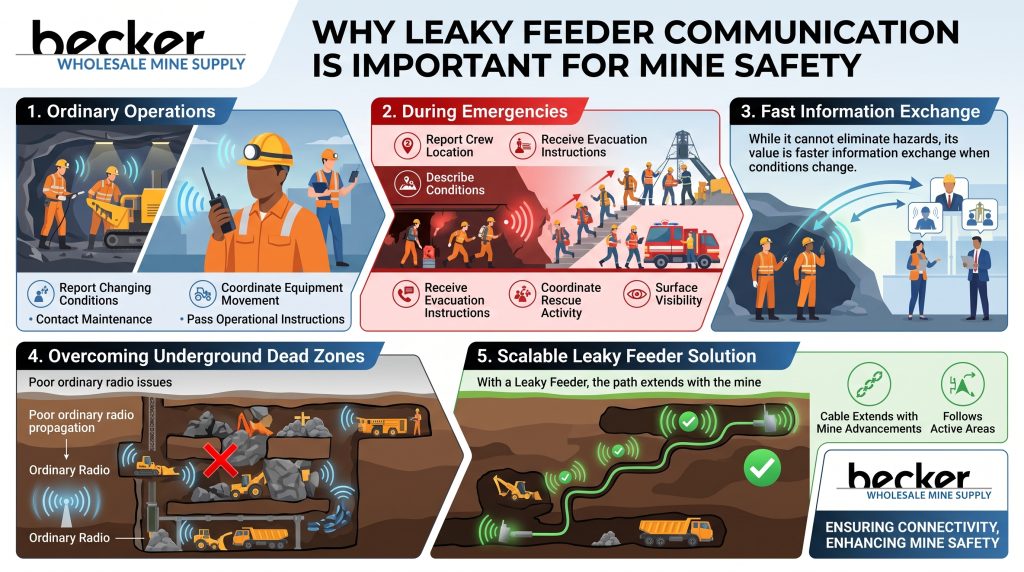
During ordinary operations, that can mean reporting changing ground conditions, coordinating equipment movement, contacting maintenance, or passing operational instructions.
During an emergency, communication becomes even more important.
Crews may need to report their location, describe conditions, receive evacuation instructions, coordinate rescue activity, or communicate changes that surface personnel cannot see directly.
A communication network cannot eliminate an underground hazard. Its value is that workers and decision-makers can exchange information faster when conditions change.
Underground Radio Dead Zones Can Delay Critical Information
Mine workings are poor environments for ordinary radio propagation.
Distance is only one factor. Turns, multiple levels, equipment, geological conditions, and the layout of the workings can all affect RF coverage.
That is why simply increasing handheld radio power is not the same as building an underground communication infrastructure.
With a leaky feeder, the communication path extends with the mine.
As the workings advance, the network can be extended with additional cable and supporting components so coverage follows active areas instead of relying on signals to penetrate the surrounding rock.
GET IN TOUCH
In a hurry? Call us at +1-724-515-4993
Leaky Feeder Systems Can Support Personnel Tracking and Data
Modern underground communication requirements often extend beyond voice.
Depending on the system configuration, a leaky feeder network may also form part of an infrastructure supporting data, telemetry, diagnostics, tagging, or personnel-location systems.
Becker Smartcom® VHF equipment supports voice and data capabilities, and certain Smartcom® amplifier configurations provide upgrade options for functions such as telemetry or integrated tag readers. Becker also offers other underground wireless equipment with tagging and real-time location system integration capabilities.
This distinction is important because communication and tracking are related functions, but they are not automatically the same thing.
Installing leaky feeder cable does not, by itself, mean every worker can be located in real time. Tracking requires the appropriate tags, readers, software, network architecture, and system design.
Mine operators evaluating a tunnel radio leaky feeder system should therefore define their requirements early:
- Is the system primarily for two-way voice?
- Is personnel tracking required?
- Does the operation need equipment telemetry?
- Will data devices use the same infrastructure?
- Are remote diagnostics important?
- Does the system need an upgrade path as the mine expands?
Those questions affect equipment selection and network architecture from the beginning.
What Makes a Leaky Feeder System Reliable Underground?
Reliable underground communication depends on the entire network, not one component.
A high-performance cable cannot compensate indefinitely for poor connectors, incorrect amplifier settings, inadequate power, damaged infrastructure, badly planned branches, or a system that has not been extended as the mine develops.
Several factors deserve attention.
Tunnel and Mine Geometry
A straight development heading has different coverage demands from a mine containing several levels, crosscuts, branches, ramps, shafts, and production areas.
A branch in the cable network introduces additional design considerations because RF energy and power may need to be distributed along more than one path.
System design should reflect the actual workings rather than assuming every underground installation behaves the same way.
Cable Condition
The leaky feeder cable itself is installed in an active industrial environment.
Mining equipment, construction work, ground movement, maintenance activity, moisture, and normal mine development can expose cable and connectors to damage.
Physical inspection matters because a communication problem may originate from damage to the cable or a connection rather than from the radio.
Amplifier Placement
Amplifiers restore signal lost along the network, but adding amplifiers without considering system levels can create new problems.
The correct design balances losses and gain across the complete cable route.
As the system expands, technicians should evaluate the new cable length, component losses, power requirements, branches, and signal levels instead of simply repeating the original layout.
Power Continuity
Amplifiers and other active components need power.
That makes power distribution part of communication-system reliability.
For safety-critical applications, operators also need to consider how the communication and tracking architecture is expected to perform if normal mine power is interrupted or portions of the underground infrastructure are damaged.
For U.S. underground coal mines, MSHA guidance implementing the MINER Act specifically addresses post-accident communication and electronic tracking and states that systems used for these purposes must be functional, reliable, and designed to remain serviceable in a post-accident setting.
Those requirements should not be generalized automatically to every mine or tunnel project. Applicable regulations depend on the operation and jurisdiction.
Diagnostics and Maintenance
Underground communication problems are easier to correct when maintenance personnel can identify where the problem starts.
Compatible Smartcom® configurations provide local or remote diagnostic functions for monitoring system conditions and helping technicians identify problems within the network.
Diagnostics do not replace physical maintenance, but they can narrow the search.
Instead of discovering only that a radio has lost communication somewhere underground, maintenance personnel can have more information about the condition of the infrastructure supporting it.
Leaky Feeder vs. Wi-Fi Underground: Do You Need to Choose One?
Leaky feeder and underground Wi-Fi solve different communication problems, so many operations should evaluate them as complementary technologies rather than direct substitutes.
A leaky feeder network is well suited to extending two-way radio communication throughout long underground routes. Wi-Fi infrastructure is useful where higher-bandwidth IP connectivity is needed for compatible devices, applications, or data systems.
That means the right question is often not, “Which technology replaces the other?”
A better question is, “What communication does each part of the operation require?”
For example, an operation may rely on leaky feeder for portable radio coverage while using Wi-Fi or Ethernet-connected infrastructure for higher-bandwidth applications in selected areas.
Becker supports both Smartcom® leaky feeder networks and underground wireless networking technologies, which gives us the ability to look at the communication requirement as a system rather than forcing every application onto one network.
VHF or UHF Leaky Feeder: Which Is Right for a Mine?
The choice between VHF and UHF should be based on the mine’s communication requirements, existing equipment, frequency plan, underground environment, compatibility needs, and network design.
There is no single rule that says one frequency band is automatically correct for every underground operation.
At Becker Wholesale Mine Supply, we offer Smartcom® leaky feeder platforms in both VHF and UHF configurations. Our VHF platform supports multiple voice and data channels and automatic or manual gain modes, while our UHF platform provides automatic and manual gain options and remote diagnostic capabilities in supported configurations.
If an operation already has radios, frequencies, or infrastructure in place, compatibility may be just as important as theoretical RF performance.
For a new installation, the design process should start with the mine layout and communication objectives rather than choosing a frequency first and forcing the rest of the system around it.
How Mine Expansion Changes Leaky Feeder Requirements
A mine communication system is rarely static.
Development advances. New headings open. Old areas close. Production moves. Cable is extended. Equipment locations change.
A leaky feeder system therefore has to be maintainable and expandable.
When an underground network grows, operators should reassess more than cable length. Expansion can affect:
- Total RF loss
- Amplifier requirements
- System power
- Branching
- Terminations
- Coverage around new workings
- Tracking-reader placement
- Diagnostic visibility
- Emergency communication plans
An extension that looks simple on a map may change several parts of the communication system.
Planning for expansion during the original design can reduce the amount of equipment that needs to be replaced later.
What Should Mine Operators Evaluate Before Installing a Leaky Feeder System?
Before selecting equipment, define what the communication system actually has to accomplish.
A useful evaluation begins with the underground layout and moves outward from there.
1. Map the Required Coverage
Identify active headings, ramps, haulage routes, shops, refuge areas, shafts, portals, fixed facilities, and other locations where dependable communication is needed.
Do not assume that running cable down the main entry automatically covers every working area.
2. Define the Communication Functions
Determine whether the system needs to support voice only or additional functions such as data, telemetry, tracking, remote diagnostics, or equipment monitoring.
Adding these capabilities later may be possible, but planning for them early can simplify the architecture.
3. Consider How the Mine Will Change
A system designed only for today’s workings can become difficult to manage as development continues.
Look at where production is expected to move and how quickly cable extensions may be needed.
4. Evaluate Maintenance Access
Communication equipment installed underground eventually has to be inspected, repaired, adjusted, or replaced.
Component placement should account for access as well as RF performance.
5. Verify Applicable Safety Requirements
Communication and tracking regulations vary according to mine type and jurisdiction.
For U.S. underground coal mines, the MINER Act established specific requirements involving emergency response plans, two-way post-accident communication, and electronic tracking.
Operators should evaluate the rules that apply specifically to their site rather than treating any general communication system as automatic regulatory compliance.
Why Work With Becker Wholesale Mine Supply?
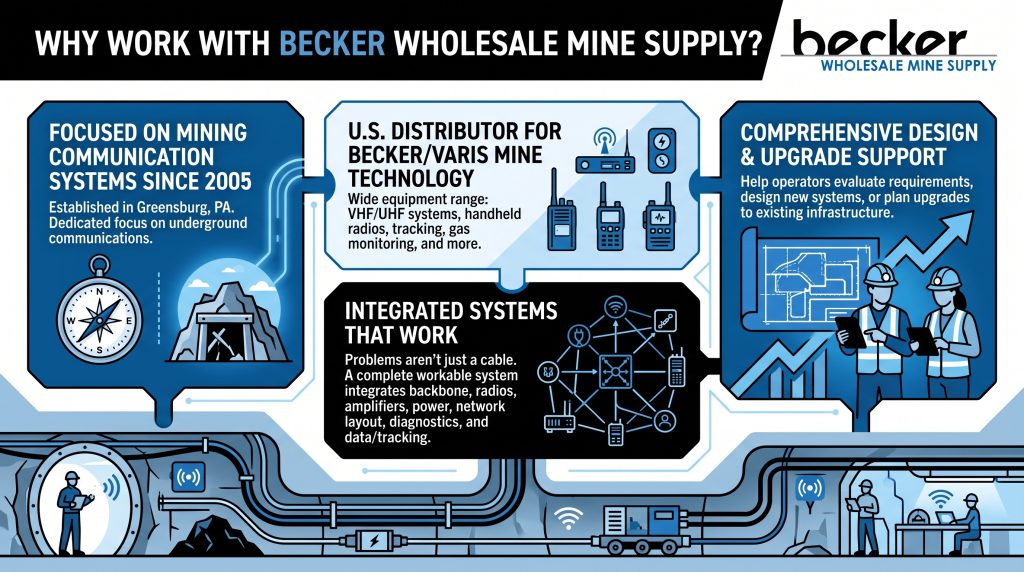
We have focused on mining communication systems since Becker Wholesale Mine Supply was established in Greensburg, Pennsylvania, in 2005.
As the U.S. distributor for Becker/Varis Mine Technology, our work includes VHF and UHF communication systems as well as handheld radios, tagging and tracking technologies, gas monitoring, and other equipment used in mining, tunneling, and related industries.
That range matters because underground communication problems rarely stop at choosing a cable.
A workable system has to bring together the communication backbone, radios, amplifiers, power, network layout, diagnostics, and any required data or tracking functions.
We can help operators evaluate those requirements when designing a new system or planning an upgrade to existing underground communication infrastructure.
GET IN TOUCH
In a hurry? Call us at +1-724-515-4993
Build Underground Communication Around the Mine, Not Around a Generic Layout
A tunnel radio leaky feeder system works best when the network is designed around the real underground environment.
Cable routes matter. So do amplifier locations, branches, power, frequencies, radios, tracking requirements, maintenance access, future mine development, and the conditions the system may need to operate through.
At Becker Wholesale Mine Supply, we provide Smartcom® VHF and UHF leaky feeder solutions and related underground communication technologies for mining and tunneling operations.
If you are planning a new underground communication network or evaluating an existing system, contact us to discuss the mine layout, coverage requirements, communication functions, and expansion plans before selecting the final system configuration.
Frequently Asked Questions
Q: How does a leaky feeder improve underground radio coverage?
A: A leaky feeder improves underground radio coverage by extending a radiating cable throughout the workings. Portable radios communicate with the nearby cable instead of depending on one radio signal to travel through long distances of rock and complex tunnel geometry. The cable carries the RF signal through the network and radiates it again where users need coverage.
Q: How far apart are leaky feeder amplifiers installed?
A: Amplifier spacing depends on the equipment and overall RF design. Some Becker Smartcom® configurations use nominal spacing around 350 meters, but cable loss, branches, connectors, operating frequencies, gain settings, and other components can change the required spacing. A site-specific system design is more reliable than applying a universal distance.
Q: Can leaky feeder systems track miners underground?
A: A leaky feeder network can support infrastructure used for personnel tracking, but tracking requires more than the radiating cable itself. Tags, readers or location hardware, software, and an appropriate network design are needed. Certain Becker Smartcom® configurations can be upgraded with tag-reader capabilities, and Becker also provides underground technologies designed to integrate with real-time location systems.
Q: Can leaky feeder carry data as well as voice?
A: Yes. Depending on the platform and configuration, modern leaky feeder systems can support voice and data. Becker’s Smartcom® VHF system, for example, supports multiple voice and data channels and can be configured with additional data capabilities.
Q: What happens when a mine extends farther underground?
A: The leaky feeder network can be extended as mine development advances, but the extension should be engineered rather than treated as cable alone. Added distance can affect signal loss, amplifier placement, power requirements, branches, tracking coverage, and diagnostics.
Products That We Offer
- VHF Leaky Feeder System
- UHF Leaky Feeder System
- SMARTSENSE®FIXED MONITOR
- RNG-500VHF Leaky Feeder Cable
- UHF Low Loss Leaky Feeder Cable
- Kenwood NX-203/303 Radios
Take control of your mining communication systems today! With Becker Wholesale Mine Supply, the leading manufacturer in the USA. Contact us now and revolutionize your mining communication systems!