Reliable Underground Communication Equipment Solutions
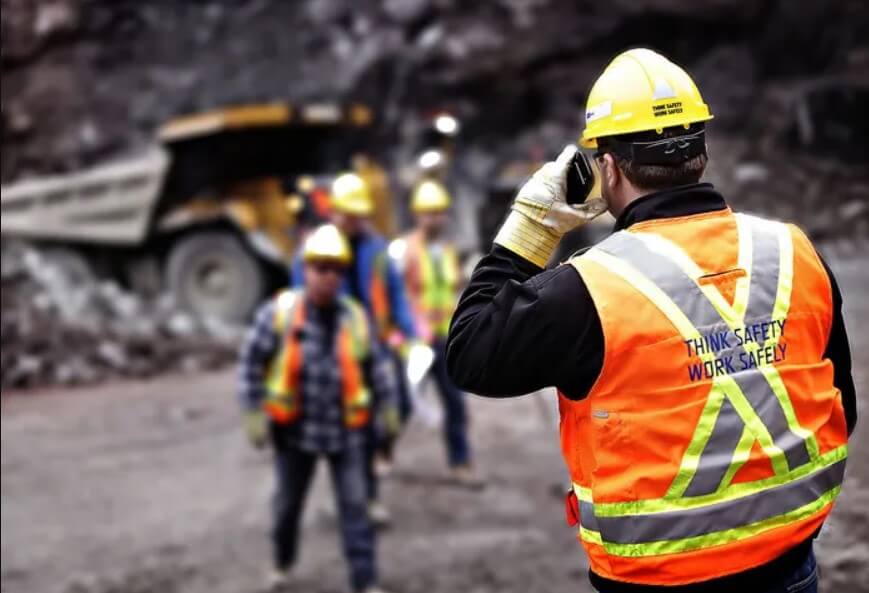
In underground mining, communication is not simply a convenience—it is a critical safety and operational requirement. Down in the dark, reliable underground communication equipment keeps crews connected, slashes emergency response times, minimizes production stoppages, and streamlines haulage coordination across active faces. Without a dependable link to the surface, routine maintenance turns into a dangerous gamble. Becker Wholesale Mine Supply delivers advanced technical networks built for the harsh realities of active mining environments across the United States. We eliminate blind spots so your crew stays safe, productive, and constantly connected.
Key Takeaways
- Deploys rugged safety lifelines by maintaining continuous voice and data feeds across unstable, high-risk mining environments.
- Slashes expensive downtime incidents through immediate, real-time maintenance dispatching directly to broken equipment downhole.
- Maximizes signal propagation across winding headings using specialized radiating coaxial cables engineered to resist moisture and crushing.
- Integrates atmospheric and tracking diagnostics to locate isolated miners instantly during emergency evacuations or ventilation failures.
- Delivers field-proven technical hardware backed by responsive, MSHA-conscious engineering teams who understand active mine environments.
Why Is Communication So Important in Underground Mining?
Underground mining operations rely on instant connectivity to mitigate hazards and maintain haulage production cycles. When standard wireless signals fail against solid rock walls, specialized underground communication equipment bridges the gap to prevent catastrophic delays. The reality on the ground is that an unmonitored heading can turn hazardous in minutes, making immediate contact an operational necessity.
Continuous Deep-Mine Operational Benefits
- Coordinate haulage fleets by routing load-haul-dump machines dynamically to maximize daily tonnage outputs.
- Broadcast atmospheric alerts instantly to trigger immediate evacuations when methane or carbon monoxide levels spike.
- Track personnel locations continuously to verify accountability zone by zone before blasting sequences begin.
- Accelerate mechanical repairs by letting mechanics text diagnostic fault codes directly to surface parts coordinators.
- Eliminate transit delays by keeping haulage dispatchers and longwall operators perfectly synchronized shift after shift.
When communication systems function properly, supervisors can make informed decisions based on real-time information. If an issue occurs, workers can immediately report concerns and receive guidance without unnecessary delays. In many situations, dependable communication can significantly improve response times during incidents, helping protect both personnel and equipment.
What Challenges Affect Underground Communication Systems?
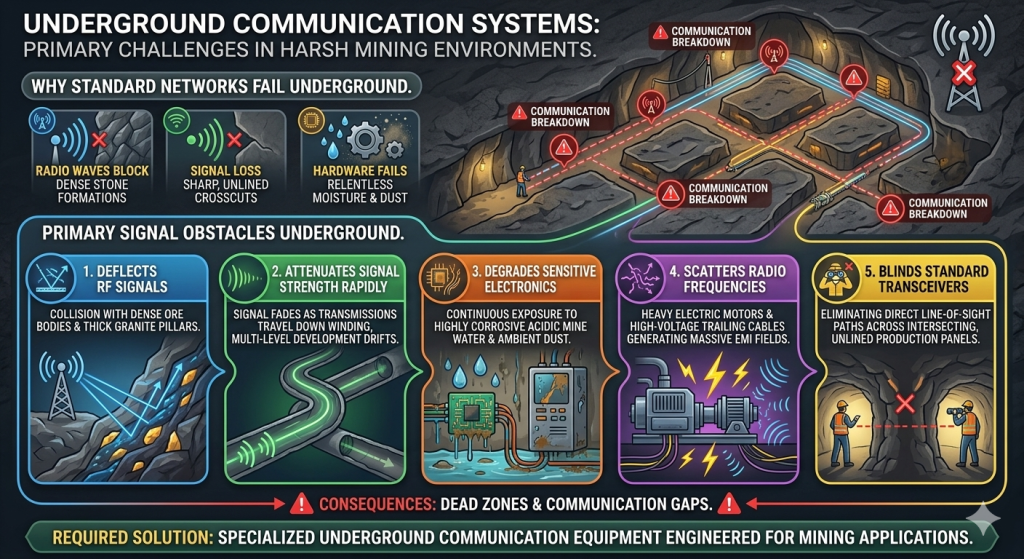
Solid rock barriers, miles of tight tunnels, and high electromagnetic interference routinely destroy standard communication networks. Traditional wireless systems fail underground because radio waves cannot penetrate dense stone formations or wrap around sharp, unlined crosscuts. Here is the part most contractors won’t tell you: standard industrial hardware crumbles under the relentless moisture and dust of an active mine.
Primary Signal Obstacles Underground
- Deflects RF signals when radio waves collide with dense ore bodies and thick granite pillars.
- Attenuates signal strength rapidly as wireless transmissions travel down winding, multi-level development drifts.
- Degrades sensitive electronics via continuous exposure to highly corrosive acidic mine water and ambient dust.
- Scatters radio frequencies due to heavy electric motors and high-voltage trailing cables generating massive EMI fields.
- Blinds standard transceivers by eliminating direct line-of-sight paths across intersecting, unlined production panels.
These conditions can create dead zones and communication gaps if systems are not specifically engineered for mining applications. That is why mining operations require specialized underground communication equipment designed to perform reliably under demanding conditions.
GET IN TOUCH
In a hurry? Call us at +1-724-515-4993
How Does Leaky Feeder Technology Solve Deep-Mine Dead Zones?
Leaky feeder systems utilize a specialized, radiating coaxial cable that acts as a continuous antenna down the entire mine shaft. This layout allows VHF and UHF radio signals to emit from the cable constantly, ensuring clear two-way communication anywhere along the tunnel line. Instead of relying on a single tower, your hand-held radios talk directly to the cable running overhead.
Technical Breakdown of Becker Leaky Feeder Networks
- The Core Backbone Transmission Line
- Installs continuous radiating cable along mine roofs to project stable RF fields down every intersecting crosscut.
- Resists heavy impacts from low-clearance machinery using thick, fire-retardant outer jackets built for tight underground spaces.
- Inline Bidirectional Amplifiers
- Boosts signal strength at fixed intervals to overcome natural RF attenuation across miles of deep workings.
- Maintains continuous data paths even if standard mine power grids fail by utilizing integrated backup battery banks.
- Multi-Channel Headend Integration
- Unites surface dispatch centers with deep underground production crews over a single, high-bandwidth network framework.
- Supports simultaneous channels for distinct operations, keeping haulage crews, mechanics, and rescue teams on independent lines.
How Do Digital Radios Outperform Legacy Analog Networks Down Hole?
Digital radio networks deliver crisp, noise-canceling voice transmissions while packing advanced emergency signaling directly into your miner’s belt pack. Legacy analog radios pick up every hum, hiss, and motor whine from active continuous miners, muddying vital safety commands. Digital transceivers filter out background machinery roar, ensuring critical evacuation orders are heard clearly the first time.
Digital Audio and Data Performance
- Filters high-decibel equipment roar to deliver pristine, intelligible voice transmissions across noisy longwall setups.
- Embeds dedicated panic triggers that instantly flash a miner’s exact location to surface command centers during emergencies.
- Tracks real-time battery diagnostics to warn safety supervisors before an individual miner’s transceiver loses power.
Operational Coordination and Dispatch
- Segments distinct work crews into dedicated digital talk groups to eliminate chaotic radio traffic across the main channel.
- Enables private individual calling so mechanics can troubleshoot sensitive system failures directly with surface engineers without interrupting haulage.
- Logs all radio traffic automatically to provide compliance records for internal safety audits and post-incident reviews.
Which Specialized Infrastructure Cables Prevent System Blackouts?
Rugged, mine-grade cables act as the physical lifeline for every transceiver, sensor, and amplifier installed downhole. Becker Wholesale Mine Supply engineers heavy-duty cables that resist slicing, chemical rot, and severe tension pulled along winding drift walls. If your cable jacket splits under the weight of shifting strata, your entire production loop goes completely dark.
| Cable Model & Component Type | Primary Technical Specification | Underground Survival Value |
| RNG-500 VHF Leaky Feeder | Dual-shielded radiating copper braid with low-smoke, non-halogen specialized outer jacket. | Prevents complete signal loss around 90-degree crosscuts while resisting toxic smoke emission during thermal events. |
| UHF Low Loss Leaky Feeder | High-velocity foam dielectric center with optimized slot patterns for higher frequency bands. | Extends digital data range across massive open pit transitions and long, straight haulage declines. |
| Heavy-Duty Network Components | IP68 waterproof line splitters, heavy-duty brass connectors, and armored junction enclosures. | Seals out highly corrosive mine water and fine rock dust to protect critical network junctions from short-circuiting. |
What Key Entities Ground Your Underground Network Infrastructure?
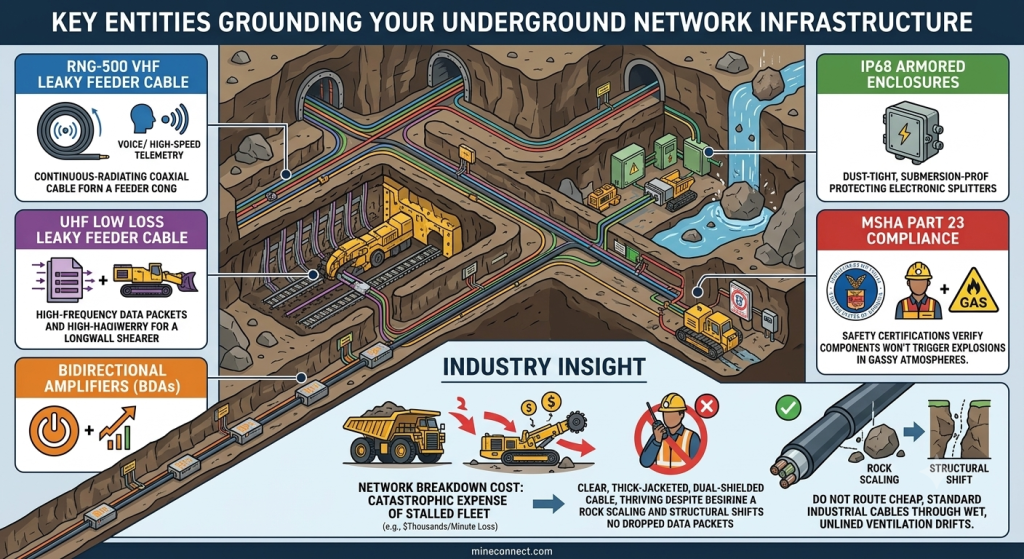
- RNG-500 VHF Leaky Feeder Cable: A specialized, continuous-radiating coaxial lifeline engineered to pass voice and high-speed telemetry across remote mine headings.
- UHF Low Loss Leaky Feeder Cable: High-frequency radiating infrastructure optimized to carry complex digital data packets deeper into high-interference longwall operations.
- Bidirectional Amplifiers (BDAs): Inline signal boosters spaced strategically along the cable run to combat signal degradation over long distances.
- IP68 Armored Enclosures: Dust-tight, submersion-proof junction boxes designed to protect active electronic splitters from crushing impacts and mine water.
- MSHA Part 23 Compliance: Strict federal safety certifications verifying that electronic communication components will not trigger explosions in gassy atmospheres.
Industry Insight
The true cost of a network breakdown isn’t the price of replacement cable—it is the catastrophic expense of a stalled haulage fleet. If a continuous miner goes down and the operator cannot radio the mechanic immediately, your operation loses thousands of dollars every single minute that machine sits idle. Do not route cheap, standard industrial cables through wet, unlined ventilation drifts. Always specify thick-jacketed, dual-shielded radiating lines that survive structural shifting and routine rock scaling without dropping a single packet of data.
GET IN TOUCH
In a hurry? Call us at +1-724-515-4993
Putting Your Underground Communication Strategy into Motion
To secure your production faces, minimize operational blind spots, and protect your crew from isolated network failures, implement this field-tested communication roadmap:
- Map Your Active Coverage Gaps
- Walk every development drift and remote pump station with an RF meter to log hidden dead zones.
- Document all localized machinery layouts creating severe electromagnetic interference against standard radio frequencies.
- Deploy the Becker Radiating Backbone
- Hang heavy-duty RNG-500 leaky feeder cables along primary haulage roads and secondary escapeways.
- Space the inline bidirectional amplifiers out carefully to guarantee uniform signal propagation across expanding mine sections.
- Integrate Digital Radios and Sensors
- Issue noise-canceling digital transceivers equipped with active telemetry and dedicated emergency distress buttons.
- Link your atmospheric gas monitors directly into the leaky feeder network for automatic surface alerts.
Call Becker Wholesale Mine Supply to optimize your underground communication equipment network today.
Frequently Asked Questions
Q: What is underground communication equipment?
A: Underground communication equipment consists of specialized radiating leaky feeder cables, industrial transceivers, bidirectional amplifiers, and rugged network connectors. These heavy-duty components are engineered specifically to survive crushing forces, moisture, dust, and severe electromagnetic interference inside underground mining operations.
Q: What is a leaky feeder system?
A: A leaky feeder system utilizes a specialized coaxial cable with engineered gaps in its outer shielding that allow radio signals to “leak” out continuously along its length. The cable acts as a miles-long, uninterrupted antenna, providing clear two-way radio coverage throughout winding tunnels where standard wireless signals cannot travel.
Q: Why is communication important in underground mining?
A: Reliable communication is vital for maintaining worker safety, accelerating emergency rescue response, monitoring atmospheric hazards, and coordinating daily haulage operations. Without active network lines, mechanical breakdowns stall production cycles unnecessarily, and isolated crews cannot be notified of sudden environmental dangers down hole.
Q: Can communication systems integrate with worker tracking technology?
A: Modern underground network infrastructures easily integrate personnel tracking tags, machine telemetry modules, and real-time gas detection sensors onto the same cable backbone. This unified data feed lets surface dispatchers pinpoint miner locations instantly during emergency evacuations and monitor hazardous gas shifts remotely.
Q: How often should mining communication systems be inspected?
A: Network components should be inspected weekly alongside routine safety walks, checking for physical cable tears, loose mechanical splices, and moisture entry. Regular diagnostic testing of backup battery systems and amplifier outputs ensures the entire lifesaver network remains functional when primary mine power fails.
Products That We Offer
- VHF Leaky Feeder System
- UHF Leaky Feeder System
- SMARTSENSE®FIXED MONITOR
- RNG-500VHF Leaky Feeder Cable
- UHF Low Loss Leaky Feeder Cable
- Kenwood NX-203/303 Radios
Take control of your mining communication systems today! With Becker Wholesale Mine Supply, the leading manufacturer in the USA. Contact us now and revolutionize your mining communication systems!