Upgrade Mine Safety With an Underground Gas Detector
Gas conditions underground can change quickly. Ventilation shifts, blasting, diesel equipment, geological conditions, and work in confined or poorly ventilated areas can all affect the atmosphere miners depend on. An underground gas detector gives mine personnel a way to identify dangerous changes before workers have to rely on symptoms, smell, or visible warning signs. Modern systems can continuously monitor several gases, activate local alarms, record changing conditions, and connect gas data with a wider mine safety and communication network.
At Becker Wholesale Mine Supply, we provide gas monitoring alongside the communication, tracking, and monitoring technologies used in demanding U.S. mining environments. Our goal is not simply to put another sensor underground. A useful gas monitoring system has to detect the right hazards, provide an actionable warning, and fit the way the mine actually operates.
Key Takeaways
- An underground gas detector can continuously identify changes in methane, carbon monoxide, oxygen, and other gases selected for the mine’s actual hazards.
- Fixed detectors provide continuous monitoring at important locations, while portable detectors help workers assess changing work areas and localized conditions.
- Detector placement matters as much as sensor selection because gas hazards and ventilation conditions vary throughout a mine.
- Gas alarms become more useful when readings can reach personnel or a control location instead of remaining only at the sensor.
- Calibration, testing, alarm configuration, maintenance, and recordkeeping are critical parts of a reliable gas detection program.
- MSHA requirements differ by mine type and application, so operators should verify that detectors and monitoring arrangements meet the rules that apply to their operation.
Why Is an Underground Gas Detector Important for Mine Safety?
An underground gas detector provides early warning when the mine atmosphere moves toward potentially hazardous conditions. Depending on the sensing configuration, it can identify combustible gases, toxic gases, or oxygen conditions that workers may not be able to recognize without instrumentation.
That matters because underground air is rarely uniform.
Conditions near an active face can differ from conditions along a haulage route. A return airway can carry contaminants from another part of the mine. Blasting may temporarily change atmospheric conditions, while diesel-powered equipment can introduce combustion-related contaminants into areas where crews are working.
Continuous monitoring helps turn those invisible changes into usable information.
For certain underground coal mine applications, federal requirements specifically address approved gas detection equipment. For example, MSHA rules require mine operators to provide an approved handheld multi-gas detector capable of measuring methane, oxygen, and carbon monoxide to groups of underground miners and individuals working alone under the applicable regulation. MSHA also specifies requirements for methane and oxygen testing equipment in underground coal mines.
Compliance should always be evaluated against the mine type, equipment application, installation, and current MSHA requirements rather than assuming one detector configuration fits every operation.
What Gases Should an Underground Mine Monitor?
The correct gases depend on the mine, geological conditions, equipment, ventilation design, work activity, and identified hazards. A multi-gas system allows operators to select sensors around those actual risks instead of treating every underground location the same way.
Common monitoring targets can include:
Methane (CH₄). Methane is particularly important in underground coal mining because an accumulation can create an explosive atmosphere. Monitoring helps personnel recognize rising concentrations before conditions become more dangerous.
Carbon monoxide (CO). Carbon monoxide may be associated with combustion, fires, blasting, or engine exhaust. Because workers cannot depend on smell or appearance to detect CO safely, instrumentation is necessary where it is a recognized hazard.
Oxygen (O₂). A detector can identify oxygen-deficient conditions that may develop in enclosed, stagnant, sealed, or otherwise poorly ventilated areas.
Hydrogen sulfide (H₂S). H₂S may be a concern in some underground environments, including areas associated with certain geological formations, mine water, sumps, or drainage conditions.
Nitrogen dioxide (NO₂). Diesel exhaust and blasting can make nitrogen dioxide monitoring relevant in some operations.
Depending on the application, additional gases or environmental measurements may also be appropriate.
Our SMARTSENSE® SSFM-100 fixed monitor can be configured with up to four integrated gas sensors. Published specifications include sensing options for carbon monoxide, oxygen, methane, carbon dioxide, sulfur dioxide, hydrogen sulfide, and nitrogen dioxide, along with temperature, humidity, and air velocity options.
The key decision is not simply how many gases a detector can measure. It is which measurements provide useful safety information at a particular location in your mine.
Fixed vs. Portable Gas Detectors: Why Mines May Need Both
Fixed and portable gas detectors solve different monitoring problems. In many operations, they work best as complementary layers rather than interchangeable alternatives.
| Monitoring Type | Best Suited For | Main Advantage | Important Limitation |
| Fixed gas detector | Continuous monitoring at selected locations | Watches the area continuously without requiring a worker to be present | Only measures the atmosphere where its sensor can effectively sample |
| Portable gas detector | Worker-carried testing, inspections, changing work areas, pre-entry checks | Moves with personnel and can identify localized conditions | Protection depends on proper use, testing, maintenance, and workers carrying the instrument |
A fixed detector may make sense where atmospheric conditions need ongoing observation. Portable equipment remains important when workers move beyond those fixed monitoring points or enter areas where local conditions may differ.
The competitor material reviewed for this article likewise distinguishes fixed monitoring from portable detection across mine functions such as drilling, ventilation, haulage, dewatering, explosives handling, and refuge areas.
The important point is that neither format creates complete coverage by itself.
Where Should Underground Gas Detectors Be Installed?
Underground gas detectors should be positioned according to the hazards, airflow, work activities, equipment, and monitoring objective at each location. Installing detectors at convenient mounting points without considering those variables can create blind spots.
Potential monitoring locations may include:
- active production or extraction areas
- ventilation and return-air locations
- haulage and diesel equipment areas
- conveyor or material transfer areas
- sumps and pump stations
- selected confined or poorly ventilated workings
- areas around blasting activity where monitoring is required
- refuge or emergency-support areas where applicable
The precise installation strategy should come from the mine’s hazard assessment, ventilation design, applicable regulations, and the detector manufacturer’s requirements.
Consider How the Gas Behaves
Sensor placement should reflect the physical behavior of the gas being measured as well as mine airflow.
Methane, for example, behaves differently from some heavier gases. However, simply mounting a detector “high for light gas” or “low for heavy gas” is not enough. Ventilation velocity, turbulence, equipment movement, roof geometry, obstructions, temperature, and the likely source of a release can all influence where gas reaches the detector.
That is why detector placement should be treated as an engineering and safety decision rather than a mounting exercise.
Watch the Areas Where Conditions Change
A location that normally has good airflow may behave differently after a ventilation change, equipment shutdown, fan problem, blast, or change in mine development.
Operators should therefore ask a practical question:
Where could hazardous conditions develop before our current monitoring system would detect them?
That question is often more useful than simply asking how many detectors the mine needs.
How Does Real-Time Gas Monitoring Improve Emergency Response?
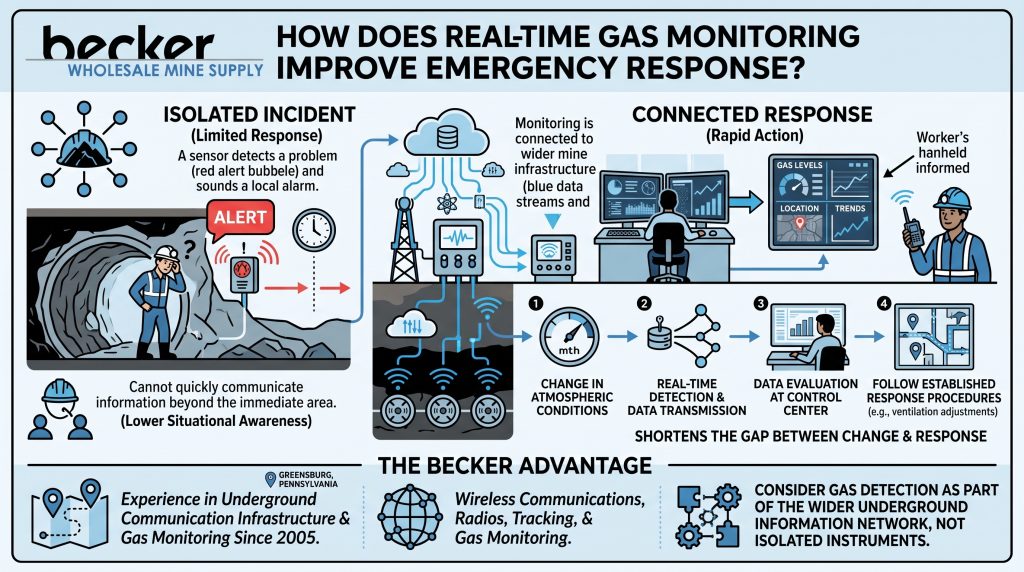
Real-time monitoring shortens the gap between a change in atmospheric conditions and the people responsible for responding to it.
A detector located underground can sound a local alarm. When monitoring is connected to broader mine infrastructure, gas information can also be communicated to another location where personnel can evaluate the situation and follow the mine’s established response procedures.
That distinction matters.
A sensor that detects a problem but cannot quickly communicate that information beyond the immediate area provides a different level of situational awareness from a connected monitoring system.
Becker Wholesale Mine Supply has experience in underground communication infrastructure as well as gas monitoring. The company was founded in Greensburg, Pennsylvania, in 2005 to address demand for mining communication systems and later expanded its offerings to include wireless communications, radios, tracking systems, and gas monitoring.
This gives mine operators an opportunity to consider gas detection as part of the wider underground information network rather than as a collection of isolated instruments.
GET IN TOUCH
In a hurry? Call us at +1-724-515-4993
Can a Gas Detector Work With Mine Ventilation Systems?
Some fixed gas monitoring equipment provides programmable outputs that can be incorporated into a properly engineered control system. This may allow a mine to use detector readings as inputs to alarms, ventilation controls, or other responses.
For example, the SMARTSENSE® SSFM-100 includes programmable alarm set points and independent programmable digital outputs. Its published specifications also list RS485 Modbus connectivity and additional digital and analog inputs.
Those capabilities can support system integration, but the control strategy has to be designed carefully.
Automatically starting or changing ventilation based on a gas reading is more complex than connecting a detector directly to a fan and assuming the system is safe. Operators have to account for:
- applicable MSHA requirements
- detector location and response time
- alarm thresholds
- sensor failure conditions
- communication or power loss
- control logic
- ventilation consequences in other mine areas
- manual override and emergency procedures
An automated response should therefore be engineered as part of the mine’s overall safety and ventilation system.
What Features Matter in an Underground Gas Detector?
The best detector is the one that reliably addresses the mine’s actual monitoring requirements. A long feature list does not compensate for poor placement, the wrong sensor, difficult maintenance, or alarms that crews cannot act on.
Multi-Gas Monitoring
A multi-gas detector can reduce the need for separate instruments when several hazards must be monitored at one point.
The SMARTSENSE® fixed monitor supports as many as four integrated gas sensors in one unit. That provides flexibility when a location requires simultaneous monitoring of several atmospheric variables.
Clear Local Alarms
Workers near the detector need to recognize an alarm quickly.
The SSFM-100 uses Becker’s 360° Alarm® design and programmable alarm set points. It also provides an auto-adjustable backlight and a display designed for visibility in underground or surface applications.
Useful Data and Alarm History
A monitoring system should provide more than a momentary warning.
The SSFM-100 stores calibration records, alarm history, and data logs. Those records can help personnel review what occurred around an alarm event and maintain a clearer history of detector performance.
Rugged Environmental Protection
Dust, water, vibration, temperature changes, and difficult access are part of underground equipment selection.
Published specifications for the SSFM-100 list an IP67 rating, an operating temperature range of -20°C to +40°C, and up to 90% non-condensing humidity. Site suitability still needs to be evaluated against the actual conditions and approval requirements of the proposed installation.
Connectivity
A detector becomes more useful when its information can be incorporated into a larger monitoring architecture.
The SSFM-100 provides RS485 Modbus connectivity together with external digital and analog inputs and programmable digital outputs.
That flexibility can help mines design monitoring around their infrastructure instead of treating every detector as an isolated device.
Why Calibration and Maintenance Matter as Much as Detection
An underground gas detector is only useful when mine personnel can trust the reading.
Sensors can drift, become contaminated, age, suffer physical damage, or respond differently when environmental conditions change. A detector that powers on is not automatically a detector that is measuring accurately.
A sound maintenance program should address the manufacturer’s requirements and the regulations applicable to the detector’s use. Depending on the equipment and application, that can include inspection, functional testing, calibration, sensor replacement, alarm verification, and documentation.
For underground coal mines, MSHA specifies that methane detectors used for required tests be approved, maintained in permissible and proper operating condition, and calibrated with a known methane-air mixture at least every 31 days. The regulation also addresses approved oxygen detectors and their required measuring capability.
That regulatory example illustrates a broader safety principle: gas detection cannot be treated as install-it-and-forget-it equipment.
How Should a Mine Choose an Underground Gas Detector?
Start with the hazard and operating environment, not the product catalog.
Before selecting equipment, mine operators should be able to answer questions such as:
- Which gases can realistically occur here?
Consider geology, blasting, diesel equipment, mine water, fires, ventilation, and process-specific hazards. - Where could those gases accumulate or travel?
Review airflow, work areas, returns, dead ends, equipment locations, and changing mine development. - Do we need continuous fixed monitoring, portable testing, or both?
The answer may differ from one part of the mine to another. - Who needs to receive the alarm?
A local alarm may be appropriate in one application, while another may need information sent to a control or communication system. - What should happen after the alarm?
Define the response before choosing the hardware. - How will the detector be tested, calibrated, and maintained?
Equipment that is difficult to service can become a weak point in an otherwise well-designed monitoring program. - What MSHA approvals or regulatory requirements apply?
Requirements depend on the mine and the equipment’s intended use. Do not assume that a feature described as suitable for mining automatically satisfies every regulated application.
This approach helps avoid a common mistake: choosing a capable detector and only afterward trying to decide where it belongs.
Why Gas Detection Should Be Part of a Connected Mine Safety System
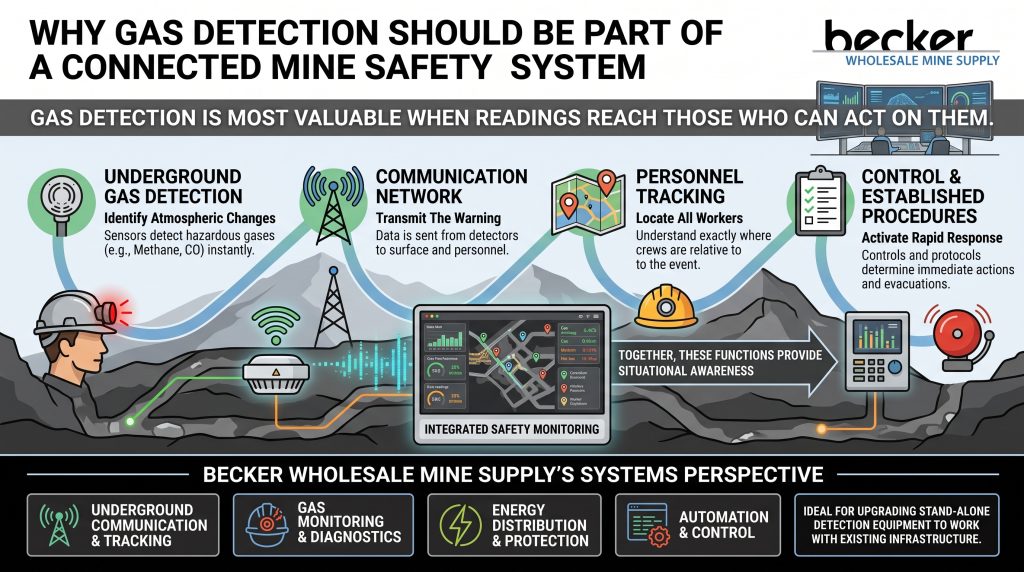
Gas detection becomes more valuable when the reading reaches the people who can act on it.
An underground detector can identify a change in the atmosphere. A communication network can help move that warning. Tracking technology may help personnel understand where workers are located. Controls and established procedures determine what happens next.
Together, those functions give the mine better situational awareness than any one device can provide alone.
At Becker Wholesale Mine Supply, our background extends across underground communication, tracking, diagnostics, monitoring, energy distribution, automation, and protection technologies for mining and other demanding industries.
That systems perspective is especially useful when an operation is upgrading older stand-alone detection equipment and wants gas monitoring to work with existing underground infrastructure.
GET IN TOUCH
In a hurry? Call us at +1-724-515-4993
Upgrade Your Underground Gas Monitoring Strategy
An underground gas detector should do more than confirm that a gas is present. It should give your mine useful information early enough for trained personnel and established systems to respond.
That means looking beyond the number of sensors in the enclosure.
The right approach considers the gases present, detector location, airflow, alarm communication, equipment approvals, calibration, maintenance, data logging, and how the detector fits into the rest of the mine’s safety infrastructure.
At Becker Wholesale Mine Supply, we provide mining gas monitoring solutions along with underground communication and monitoring technologies. If you are reviewing an existing system or planning a new gas monitoring installation, we can help you evaluate equipment options around the requirements of your operation.
Contact our team to discuss gas monitoring and underground safety system options for your mine.
Frequently Asked Questions
Q: What does an underground gas detector measure?
A: An underground gas detector measures one or more atmospheric conditions using sensors selected for the application. Common monitoring targets include methane, carbon monoxide, oxygen, hydrogen sulfide, carbon dioxide, and nitrogen dioxide. The gases a mine should monitor depend on its geology, equipment, work processes, ventilation, and applicable safety requirements.
Q: What is the difference between a gas detector and a gas monitor?
A: The terms are often used interchangeably. In practice, “detector” commonly emphasizes identifying a hazardous concentration and producing an alarm, while “monitor” may refer to equipment that continuously measures, displays, records, or transmits atmospheric data. Many modern underground systems perform both functions.
Q: Are fixed gas detectors better than portable detectors?
A: Neither is universally better. Fixed detectors continuously monitor selected locations, while portable detectors move with workers and can be used to check areas outside fixed coverage. Mines may use both because the two approaches address different monitoring needs.
Q: How many gases can the SMARTSENSE® Fixed Monitor detect?
A: The SMARTSENSE® SSFM-100 can accommodate up to four integrated gas sensors in one compact monitor. Available published sensing options include methane, carbon monoxide, oxygen, carbon dioxide, sulfur dioxide, hydrogen sulfide, and nitrogen dioxide.
Q: Do underground gas detectors need to be MSHA approved?
A: Approval requirements depend on the mine type, detector, location, and intended regulatory use. MSHA specifically requires approved detectors for certain testing and multi-gas detector applications in underground coal mines. Operators should verify the current requirements that apply to their installation rather than assuming that all mining gas detectors are interchangeable.
Q: Can an underground gas detector control ventilation equipment?
A: Some fixed monitors provide programmable outputs that can be incorporated into engineered ventilation or control systems. The SSFM-100, for example, includes programmable digital outputs. Any automated ventilation response should be designed around applicable regulations, mine ventilation requirements, alarm logic, failure modes, and site-specific safety procedures.
Products That We Offer
- VHF Leaky Feeder System
- UHF Leaky Feeder System
- SMARTSENSE®FIXED MONITOR
- RNG-500VHF Leaky Feeder Cable
- UHF Low Loss Leaky Feeder Cable
- Kenwood NX-203/303 Radios
Take control of your mining communication systems today! With Becker Wholesale Mine Supply, the leading manufacturer in the USA. Contact us now and revolutionize your mining communication systems!