Gas Detection Sensor Safety Guide for U.S. Mines
A gas detection sensor can give mine personnel an early warning when the atmosphere begins moving toward unsafe conditions. In underground and surface mining, that warning matters because dangerous gases may be invisible, difficult to detect without instrumentation, or capable of creating both immediate and long-term hazards. The right monitoring setup depends on more than choosing a detector that recognizes a particular gas. Mine operators also need to consider where the sensor will be installed, which gases may be present, how alarms will be communicated, how the equipment will be calibrated and maintained, and whether the equipment must meet Mine Safety and Health Administration (MSHA) approval requirements for its intended application.
At Becker Wholesale Mine Supply, we provide gas monitoring alongside communication, tracking, and other systems designed for mining environments. Our experience with underground mine infrastructure allows us to look at gas detection as part of the broader safety and communication system rather than as an isolated instrument.
Key Takeaways
- A mining gas detection sensor should be selected around the actual atmospheric hazards at the mine, not simply the number of gases a detector can measure.
- Methane, carbon monoxide, hydrogen sulfide, and oxygen are among the gases and atmospheric conditions commonly monitored in mining applications.
- Certain equipment used in underground coal and gassy underground metal and nonmetal mines may require MSHA approval or certification for the intended application.
- Fixed and portable detectors solve different problems; many mines need both personal or portable monitoring and continuous monitoring at critical locations.
- Calibration, alarm testing, placement, ventilation patterns, and sensor condition can be just as important as the sensor technology itself.
- A monitoring system that records alarms and calibration information can give safety teams useful data for maintenance, incident review, and system management.
What Does a Gas Detection Sensor Do in a Mine?
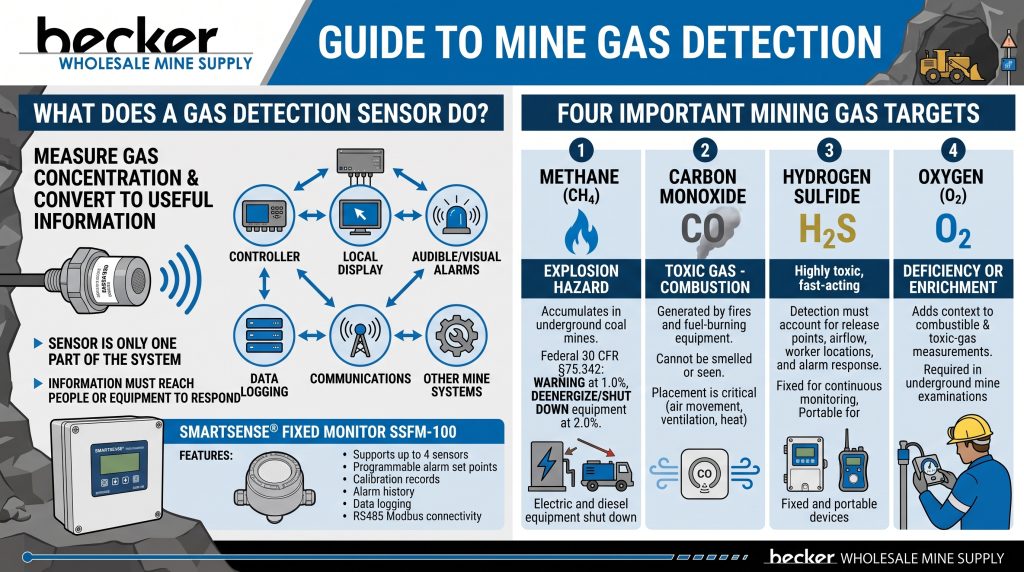
A gas detection sensor measures the concentration of a particular gas or atmospheric condition and converts that measurement into information a monitoring device can display, record, or use to trigger an alarm.
The sensor is only one part of the safety system.
Depending on the installation, a complete gas-monitoring setup may also include a controller, local display, audible or visual alarms, programmable outputs, communications infrastructure, data logging, and connections to other mine systems.
This distinction matters in mining. Detecting a hazardous concentration is useful only if the information reaches the people or equipment that need to respond.
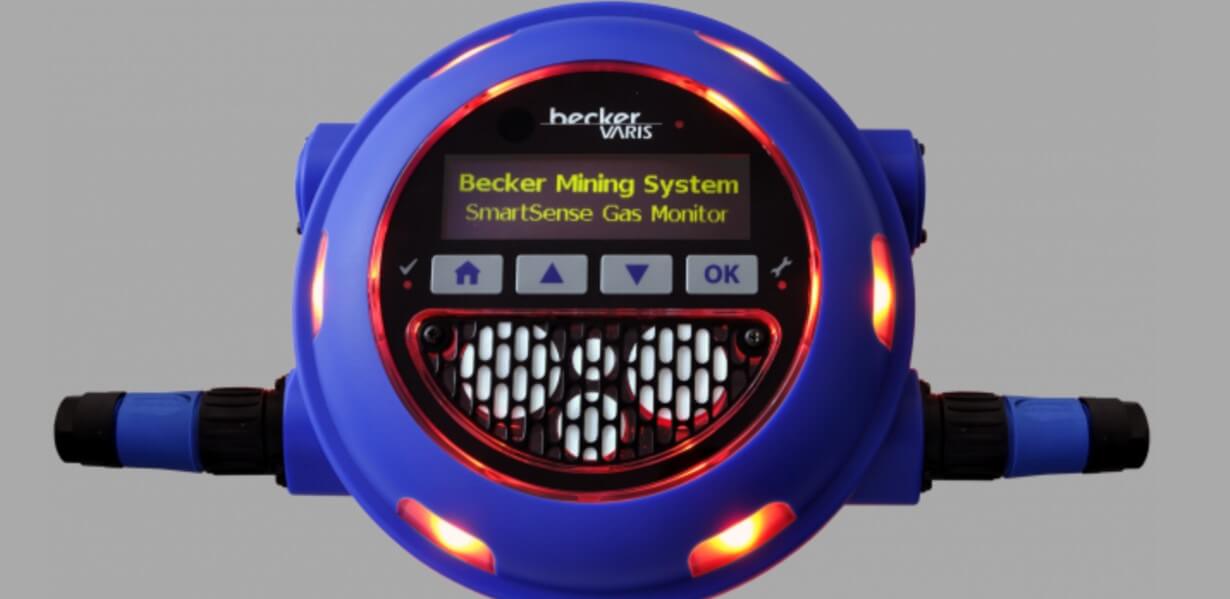
For example, our SMARTSENSE® Fixed Monitor SSFM-100 supports as many as four integrated gas sensors in one unit. It also provides programmable alarm set points, calibration records, alarm history, data logging, and RS485 Modbus connectivity.
Which Gases Should U.S. Mines Monitor?
There is no single gas-monitoring configuration that is right for every mine. The hazards depend on the mine type, geology, equipment, ventilation, work activity, and applicable regulations.
Four important monitoring targets are methane, carbon monoxide, hydrogen sulfide, and oxygen.
Methane (CH4)
Methane is a major concern in underground coal mining because it can create an explosive atmosphere when it accumulates within a flammable range.
For certain methane monitors on mining equipment, federal requirements go beyond simply displaying a reading. Under 30 CFR §75.342, applicable methane monitors must provide a warning when methane reaches 1.0% and automatically deenergize electric equipment or shut down diesel-powered equipment when methane reaches 2.0% or when the monitor is not operating properly.
That illustrates an important selection point: a methane sensor may need to perform as part of a control and shutdown system, not just as a local alarm.
Carbon Monoxide (CO)
Carbon monoxide is a toxic gas associated with combustion and can be generated by fires and fuel-burning equipment.
Because workers cannot rely on sight or smell to recognize dangerous CO concentrations, instruments provide a much more dependable means of detecting changing atmospheric conditions.
Placement also deserves attention. Air movement, ventilation, heat, equipment activity, and the location of the source can affect where CO travels. A detector placed in the wrong location may provide less useful information even if the sensor itself is working correctly.
Hydrogen Sulfide (H2S)
Hydrogen sulfide can be highly toxic, and exposure can become dangerous quickly at elevated concentrations.
Where H2S is a credible mine hazard, the detection strategy should account for likely release points, airflow, worker locations, and the response expected when an alarm occurs.
A fixed system may be useful where continuous monitoring is required, while portable monitoring can provide another layer of protection for workers entering or inspecting particular locations.
Oxygen (O2)
Oxygen monitoring identifies both oxygen-deficient and, where relevant, oxygen-enriched atmospheric conditions.
An oxygen reading also adds important context to combustible and toxic-gas measurements. Underground mine examinations may specifically require testing for oxygen deficiency as well as methane under applicable federal requirements.
GET IN TOUCH
In a hurry? Call us at +1-724-515-4993
Does a Gas Detection Sensor Need to Be MSHA Approved?
Not every gas sensor used anywhere on a mine property is subject to the same approval requirement. The correct answer depends on the mine, location, equipment, and intended use.
MSHA’s Approval and Certification Center evaluates and approves certain products for underground coal mines and gassy underground metal and nonmetal mines. Its testing covers equipment and instruments that must comply with applicable federal regulations.
For handheld multi-gas detectors, MSHA identifies applicable requirements including 30 CFR Parts 6, 18.68, and 22.
Mine operators should therefore avoid treating the phrase “MSHA compliant” as a generic product feature.
Before selecting equipment, confirm:
- The exact model and configuration
- Its approval or certification status, where required
- The gases and measurement ranges covered
- The location where it will be installed or carried
- Whether intrinsic safety or permissibility requirements apply
- Whether the detector must communicate with or shut down other equipment
The intended application determines what is required.
Fixed vs. Portable Gas Detection Sensors
Fixed and portable gas detectors serve different purposes. One does not automatically replace the other.
| Monitoring Type | Best Suited For | Main Advantage | Important Limitation |
| Fixed gas monitoring | Continuous monitoring at selected locations | Provides ongoing readings, alarms, and system integration | Only measures the atmosphere where sensors are positioned |
| Portable multi-gas detector | Inspections, entries, mobile work, personal monitoring | Travels with the worker or testing activity | Requires charging, testing, maintenance, and proper worker use |
| Machine-mounted monitoring | Gas hazards around operating equipment | Can connect detection directly to warning or shutdown functions | Placement, maintenance, and regulatory requirements are application-specific |
A fixed gas detection sensor is particularly useful where mine personnel need continuous atmospheric information from an area without depending on someone being physically present with a handheld instrument.
Portable monitors solve another problem. They allow workers to test changing locations and carry detection capability as they move.
In practice, a mine may use several monitoring layers rather than relying on one detector type.
Where Should Gas Detection Sensors Be Installed?
Gas detection sensors should be positioned according to the hazard being monitored, mine airflow, potential release points, equipment locations, and regulatory requirements.
Simply mounting a sensor where installation is convenient can create a blind spot.
Start With the Source
Ask where the gas is likely to originate.
Possible locations include:
- Working faces
- Diesel equipment areas
- Charging or battery areas
- Confined or poorly ventilated sections
- Process equipment
- Areas affected by fire or combustion hazards
- Return air routes
- Locations identified through the mine’s ventilation or safety plan
Consider Ventilation and Airflow
Mine gases do not remain neatly beside their source. Ventilation can carry them into other sections or dilute them before they reach a particular monitor.
Sensor location should therefore reflect how air actually moves through the mine.
For methane monitors subject to specific underground coal requirements, regulations may prescribe where sensing devices must be positioned in relation to equipment or working areas.
Think About What Happens After the Alarm
Detector placement is also an alarm-response decision.
Ask:
Who receives the warning?
Can workers see or hear it in the mine environment?
Does the signal reach a control room?
Should equipment shut down?
Does the monitoring system need to communicate across the mine network?
These questions can change the appropriate system design.
How Sensor Technology Affects Gas Detection
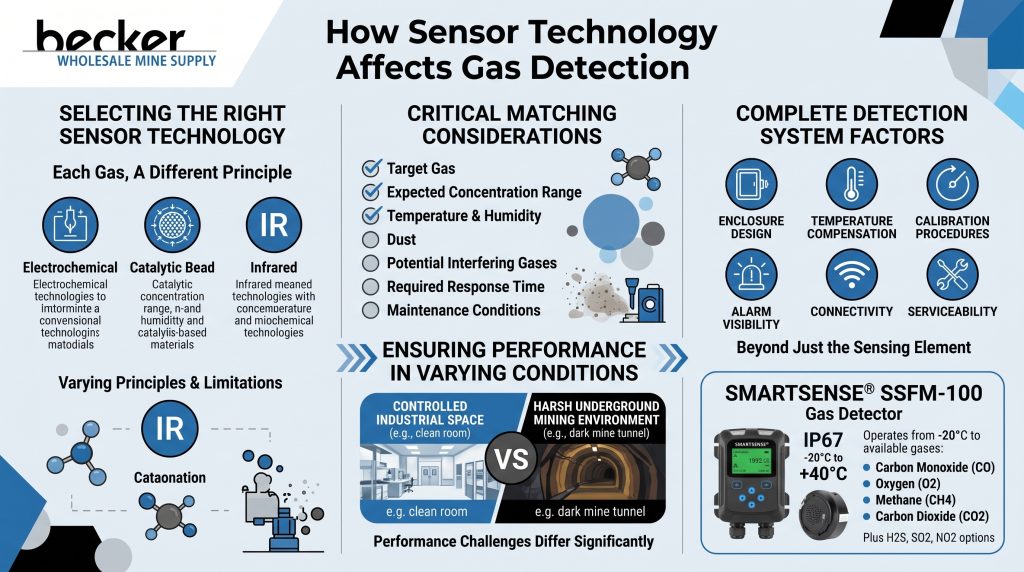
Different gases require different sensing technologies, and each technology has limitations.
Depending on the detector, sensors may use electrochemical, catalytic, infrared, or other measurement principles.
The sensor should be matched to:
- Target gas
- Expected concentration range
- Temperature
- Humidity
- Dust
- Potential interfering gases
- Required response time
- Maintenance conditions
A sensor that performs well in a controlled industrial space may face very different conditions underground.
That is why enclosure design, temperature compensation, calibration procedures, alarm visibility, connectivity, and serviceability can matter alongside the sensing element itself.
The SMARTSENSE® SSFM-100, for example, is rated IP67 and operates across a stated temperature range of -20°C to +40°C. Its available sensing configurations include carbon monoxide, oxygen, methane, carbon dioxide, and additional options including hydrogen sulfide, sulfur dioxide, and nitrogen dioxide.
GET IN TOUCH
In a hurry? Call us at +1-724-515-4993
Why Calibration Is Critical to Gas Sensor Safety
A gas detector is only useful when its readings can be trusted.
Calibration exposes the instrument to a known concentration of gas so its response can be checked and adjusted according to the manufacturer’s procedures.
A bump test has a related but different purpose. It checks whether the sensor and alarm system respond when exposed to test gas. It does not necessarily establish measurement accuracy in the same way as a full calibration.
Mine personnel responsible for detectors should follow the manufacturer’s instructions and applicable mine regulations rather than relying on a universal calibration interval.
For certain underground coal methane monitors, MSHA requires maintenance and calibration by properly trained persons and requires records of calibration tests to be retained for one year.
That recordkeeping is one reason integrated logging can be valuable.
Our SMARTSENSE® fixed monitoring platform stores calibration records and alarm history locally, helping mine personnel retain information that may support system maintenance and post-event review.
What Can Cause a Gas Detection Sensor to Give Unreliable Readings?
Sensor performance can be affected by the environment, installation, maintenance, or the sensor itself.
Common concerns include contamination, blocked sensor openings, age, exposure to concentrations outside the intended range, unsuitable temperatures, humidity, physical damage, and incorrect calibration.
Cross-sensitivity can also matter. Some sensing technologies may respond to gases other than the primary gas being measured.
This is why a detector reading should never be viewed without context.
If a monitor repeatedly drifts, fails a bump test, produces unexpected alarms, or disagrees with other measurements, the problem should be investigated rather than simply resetting the alarm.
How Should Mines Choose a Gas Detection Sensor?
Start with the hazard and operating conditions rather than the product catalog.
A useful selection process asks seven questions:
- What gases or atmospheric conditions are credible hazards?
Identify gases based on the mine type, geology, equipment, processes, and previous risk assessments. - Where must monitoring take place?
Decide whether the application requires fixed monitoring, portable testing, machine-mounted monitoring, or several layers. - What regulatory requirements apply?
Verify the relevant MSHA requirements and whether a particular product or configuration requires approval. - What must happen when a threshold is reached?
A local alarm may be sufficient in one application. Another may require remote notification, ventilation response, or equipment shutdown. - Can the sensor tolerate the mine environment?
Consider moisture, dust, temperature, vibration, physical impact, and access for maintenance. - How will the detector be tested and maintained?
Calibration and sensor replacement need to be practical enough that they occur when required. - How does the monitor connect to the rest of the mine?
Fixed monitoring becomes more useful when readings and alarms can reach the personnel responsible for responding.
That last point is particularly important in large or complex underground operations. Detection identifies the problem. Communication turns that information into action.
Building Gas Detection Into a Wider Mine Safety System
Gas monitoring works best as part of a broader mine safety infrastructure.
Becker Wholesale Mine Supply began in Greensburg, Pennsylvania, in 2005 with a focus on mine communications. We later expanded into wireless communications, tagging and tracking, handheld radios, and gas monitoring for mining and related industries.
That combination is useful because modern gas detection increasingly involves information movement as much as sensing.
A fixed monitor may generate an alarm locally, but mine safety teams may also need that information transmitted through another system, logged for later review, or connected to programmable controls.
Our SMARTSENSE® Fixed Monitor supports RS485 Modbus connectivity as well as programmable digital outputs and external inputs, allowing the monitoring point to become part of a larger control or communications architecture.
Common Gas Detection Mistakes to Avoid
A high-quality detector cannot compensate for a weak monitoring program.
Some of the most serious mistakes to avoid are choosing sensors before identifying the actual hazards, installing fixed detectors without considering airflow, assuming one portable detector provides complete mine coverage, skipping calibration or functional checks, ignoring recurring alarms, and selecting equipment without confirming the applicable MSHA requirements.
Another mistake is treating detection and response as separate issues.
Mine personnel should know what an alarm means and what action follows it. The alarm threshold, response procedure, communications path, equipment controls, and evacuation or ventilation measures need to work together.
Choose Gas Monitoring Around the Mine, Not Just the Sensor
The safest gas detection system starts with a clear understanding of the mine.
Which gases can occur? Where can they accumulate or travel? Which locations need continuous monitoring? Which workers need portable detection? What happens when an alarm activates? And how will the system be tested, maintained, documented, and connected to the mine’s broader safety infrastructure?
Those questions matter more than simply choosing a detector with the longest list of features.
At Becker Wholesale Mine Supply, we provide mine-focused gas monitoring solutions alongside the communication and monitoring infrastructure needed to move safety information where it needs to go. If you are evaluating fixed gas monitoring or looking at how gas detection can fit into a wider mine safety system, contact us to discuss the conditions and requirements at your operation.
Frequently Asked Questions
Q: What is the most important gas detection sensor in an underground mine?
A: There is no single sensor that is most important for every underground mine. Methane is a major concern in underground coal mines, while other operations may also need monitoring for carbon monoxide, hydrogen sulfide, oxygen conditions, nitrogen dioxide, or other hazards. The correct configuration depends on the mine and its risk profile.
Q: Can one detector monitor several mine gases at once?
A: Yes. Multi-gas monitors can combine several sensors in one instrument. The SMARTSENSE® Fixed Monitor SSFM-100 can accept up to four integrated gas sensors, allowing multiple atmospheric parameters to be monitored from one station.
Q: What is the difference between a gas sensor and a gas detector?
A: The sensor is the component that responds to a particular gas or atmospheric condition. The detector is the complete instrument, which may include the sensor, display, electronics, alarms, enclosure, data logging, outputs, and communications capability.
Q: Does MSHA approve gas detectors?
A: MSHA’s Approval and Certification Center approves and certifies certain equipment used in underground coal and gassy underground metal and nonmetal mines. Whether approval is required depends on the product and its intended use. Mine operators should verify the applicable regulation and exact equipment configuration before installation.
Q: How often should a mining gas detector be calibrated?
A: There is no single calibration interval that should be applied to every gas detector. Mine operators should follow the detector manufacturer’s instructions together with applicable MSHA requirements and their mine safety procedures. Certain underground coal methane monitors have specific federal calibration, maintenance, and recordkeeping requirements.
Q: Are fixed gas detectors better than portable detectors?
A: Neither is universally better. Fixed detectors provide continuous monitoring at selected points, while portable detectors allow workers to test the atmosphere as they move or enter particular areas. A complete mine gas-detection strategy may use both.
Products That We Offer
- VHF Leaky Feeder System
- UHF Leaky Feeder System
- SMARTSENSE®FIXED MONITOR
- RNG-500VHF Leaky Feeder Cable
- UHF Low Loss Leaky Feeder Cable
- Kenwood NX-203/303 Radios
Take control of your mining communication systems today! With Becker Wholesale Mine Supply, the leading manufacturer in the USA. Contact us now and revolutionize your mining communication systems!