Get a Reliable Gas Leak Detection Solution Today
Industrial operations cannot afford to guess about air quality. Hazardous gas accumulation happens silently, often escaping human senses until conditions turn critical. Implementing a field-tested gas leak detection solution helps create a reliable safety network that keeps your crew protected, preserves expensive equipment, and ensures uninterrupted shifts.
Key Takeaways
- Invisible threats develop rapidly: Dangerous gas pockets form without warning and require instrument-grade monitoring to catch.
- Continuous tracking saves lives: Real-time atmospheric data provides the early margin needed for safe evacuations and ventilation adjustments.
- Built for harsh environments: Becker Wholesale Mine Supply delivers ruggedized, field-proven hardware that survives heavy dust, moisture, and vibration.
- Operational uptime stays secure: Catching a small leak early prevents catastrophic system shutdowns, regulatory fines, and expensive machinery damage.
What Is A Gas Leak Detection Solution And Why Does It Matter?
A gas leak detection solution is an integrated safety network designed to continuously sample ambient air, pinpoint toxic or combustible gases early, and trigger automated alerts before conditions threaten human life. Industrial settings like deep-access mining, tunneling, petrochemical processing, and heavy manufacturing rely on these active systems as mandatory infrastructure to preserve worker safety and maintain site compliance.
At its core, this technology operates like an automated early warning perimeter. Industrial sensors track gas concentrations in real time, benchmark the data against strict regulatory thresholds, and broadcast immediate warnings if levels shift. This automated buffer gives your shift supervisors the exact window needed to manage risks before they spiral into catastrophic explosions, asphyxiation incidents, or systemic asset failure.
For regional operations navigating demanding environments, reliable safety engineering depends entirely on field performance. Becker Wholesale Mine Supply focuses on delivering atmospheric monitoring setups that keep running under brutal underground and surface conditions, where instrument uptime directly dictates crew survival. A properly calibrated layout answers one non-negotiable question: Is the air in this specific shaft safe to breathe right now?
Why Do Industrial Sites Need Continuous Gas Monitoring?
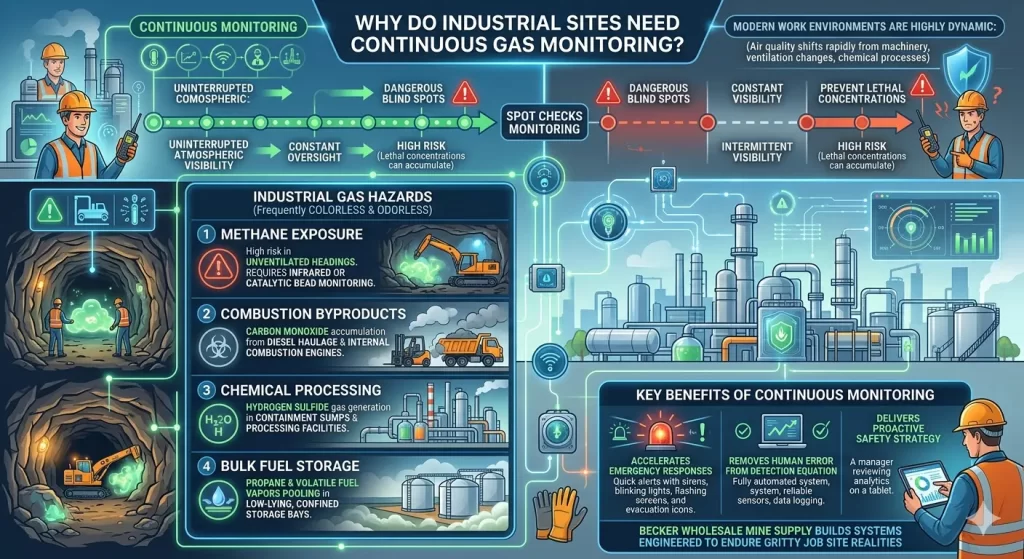
Continuous gas monitoring provides uninterrupted atmospheric visibility to prevent lethal concentrations from accumulating between manual testing intervals. Because modern work environments are highly dynamic, air quality shifts rapidly as heavy machinery runs, ventilation paths adjust, and chemical processes react. Relying solely on spot checks leaves massive, dangerous blind spots in your safety strategy.
- Methane Exposure: High risk in unventilated headings; requires infrared or catalytic bead monitoring.
- Combustion Byproducts: Carbon monoxide accumulation from diesel-powered haulage units and internal combustion engines.
- Chemical Processing: Hydrogen sulfide gas generation in containment sumps and processing facilities.
- Bulk Fuel Storage: Propane and volatile fuel vapors pooling in low-lying, confined storage bays.
These industrial hazards are frequently colorless and odorless, making them impossible for a crew to notice unaided. Waiting for manual shift testing creates unacceptable vulnerability windows. A proactive, modern monitoring framework delivers constant environmental oversight, accelerates emergency responses, and removes human error from the initial detection equation. Becker Wholesale Mine Supply builds continuous coverage systems engineered to endure actual, gritty job site realities rather than pristine laboratory conditions.
GET IN TOUCH
In a hurry? Call us at +1-724-515-4993
What Features Should A Reliable System Include?
A reliable gas detection system must combine high-sensitivity sensor elements, rugged physical enclosures, and automated alert relays to perform flawlessly under severe industrial stress. The equipment has to maintain absolute calibration accuracy while exposed to constant machine vibration, heavy airborne dust, extreme humidity, and intense temperature swings.
1. High-Sensitivity Sensors
Sensor heads must register minute fluctuations in ambient gas parts-per-million (PPM). Catching a slow leak early represents the entire boundary between standard maintenance and an emergency evacuation.
2. Real-Time Data Updates
Lagging atmospheric readings lead to delayed warnings. Continuous data telemetry ensures that control room operators base life-safety decisions on live conditions.
3. Rugged Construction
Industrial jobs demand hardened components. Field enclosures require heavy-duty ratings to withstand moisture intrusion, abrasive dust layers, impact, and heat without shifting calibration.
4. Integrated Safety Response
Monitoring hardware should tie directly into localized sirens, automated auxiliary ventilation fans, and main command dashboards for immediate, coordinated risk mitigation.
5. Multi-Channel Alerts
High-decibel audible horns, intense strobe lights, and remote control room notifications ensure critical alarms reach personnel across high-noise machinery zones.
At Becker Wholesale Mine Supply, these fundamental design choices dictate how safety systems are spec’d, deployed, and supported for industrial operations.
How Does Gas Detection Improve Mining And Industrial Safety?
Implementing a gas leak detection solution improves site safety by stopping localized gas pockets from reaching explosive or lethal thresholds inside confined workspaces. Confined areas restrict natural airflow, allowing toxic or flammable compounds to collect rapidly. Early instrument warnings allow teams to isolate leaks and step up ventilation before the atmosphere becomes unstable.
| Hazard Context | Traditional/Manual Testing | Modern Integrated Solution |
| Methane Management | Spot checks leave unmonitored windows between shifts. | Real-time sensors trigger automated auxiliary fans instantly. |
| Operational Uptime | Blind leaks lead to emergency shutdowns and lost production. | Targeted isolation allows repairs without halting the whole line. |
| Regulatory Compliance | Discontinuous paperwork leaves operations open to fines. | Digital data logging provides a clear, continuous audit trail. |
| Crew Confidence | High anxiety when working in historically volatile zones. | Visible telemetry displays reassure teams that air is safe. |
In deep mining environments, methane accumulation is an ever-present threat. Without specialized tracking, it reaches its explosive limit silently. Deploying automated detection means ventilation controls can adjust on the fly, and evacuation protocols initiate long before a spark creates a disaster. In heavy manufacturing and power generation plants, catching these leaks early prevents sudden plant trips, stops equipment destruction, limits financial loss, and keeps your operation clear of regulatory safety violations.

GET IN TOUCH
In a hurry? Call us at +1-724-515-4993
How Should Gas Detection Systems Be Implemented And Maintained?
Successful gas detection relies on a precise installation layout, strategic sensor positioning relative to gas vapor density, and strict calibration schedules. Even the most advanced instrument fails if it is mounted in a stagnant air pocket or left to drift out of calibration.
- Site Risk Assessment: Mapping localized airflow patterns, machinery emissions, and historic gas accumulation zones.
- Strategic Sensor Elevation: Mounting sensors high for buoyant gases (methane) and low for heavy vapors (hydrogen sulfide).
- Calibration & Bump Testing: Executing routine gas challenges to counteract sensor drift from environmental exposure.
- Integrated Response Drills: Training your crew to interpret specific strobe patterns and execute rapid evacuation routes.
A well-maintained safety network becomes the operational backbone of your facility. It provides the data stream needed for daily safety decisions and long-term risk management across every shift.
Practical Field Insight
Here is a reality check most equipment catalogs leave out: sensor poisoning is your main enemy. Exposing standard sensor heads to common industrial elements like silicone sprays, heavy lubricants, or specialized cleaning solvents can permanently deaden their responsiveness without tripping a system fault. If your crew is running maintenance or spraying coatings near your monitoring heads, always use protective covers or verify sensor responsiveness with a manual bump test immediately afterward. A sensor displaying zero gas because it is chemically blinded is a massive hidden risk.
Putting Your Gas Safety Strategy Into Motion
Industrial atmospheric hazards require a proactive approach to prevent avoidable site accidents. Implementing a dependable, field-tested safety setup gives your management team real-time visibility, faster emergency coordination, and solid protection for your crew and equipment. By working with Becker Wholesale Mine Supply to deploy rugged gas monitoring systems, your operation gains heavy-duty safety tools designed to handle actual field abuse. Investing in a dependable gas leak detection solution isn’t just about ticking a compliance box—it’s about protecting lives, securing operational continuity, and managing preventable risk where every second counts.
Frequently Asked Questions
Q: What are the main uses for an industrial gas detection system?
A: These systems continuously scan air quality in high-risk zones to identify hazardous gases early. They trigger automated alerts and safety steps to protect crews from explosions, poisoning, or oxygen deficiency.
Q: How often do industrial gas sensors need calibration?
A: Most industrial sensors need regular calibration every 3 to 6 months based on manufacturer rules and site conditions. High-dust or high-humidity areas usually need more frequent testing to ensure accuracy.
Q: Can these gas detection setups handle underground mining conditions?
A: Yes. Heavy-duty detection systems are purpose-built for underground mining. They are engineered to track methane, carbon monoxide, and other dangerous gases within tight, unventilated headings and main haulage ways.
Q: Which industries have the highest need for continuous gas monitoring?
A: Mining, tunneling, oil and gas processing, chemical manufacturing, and bulk energy production facilities require continuous monitoring due to their inherent risk of toxic or explosive gas buildup.
Q: Why should our operation source safety hardware from Becker Wholesale Mine Supply?
A: Becker Wholesale Mine Supply specializes in heavy-duty, industrial-grade safety systems built for brutal field environments. Their hardware focus centers on maximum reliability and accuracy where equipment downtime is not an option.
Products That We Offer
- VHF Leaky Feeder System
- UHF Leaky Feeder System
- SMARTSENSE®FIXED MONITOR
- RNG-500VHF Leaky Feeder Cable
- UHF Low Loss Leaky Feeder Cable
- Kenwood NX-203/303 Radios
Take control of your mining communication systems today! With Becker Wholesale Mine Supply, the leading manufacturer in the USA. Contact us now and revolutionize your mining communication systems!