Signs Your Fixed Gas Detector System Needs Upgrading
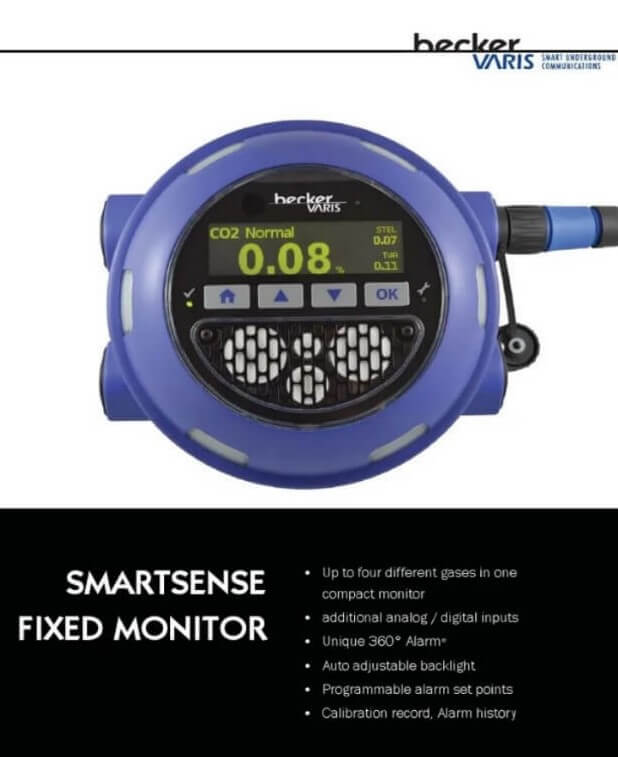
The margins for error in deep underground shafts and sprawling surface operations do not exist. When an aging fixed gas detector system starts flashing false warnings or dropping offline, it does more than stall your production schedule. It actively risks lives. Outdated monitoring setups lack the processing speed and digital backbone required to track toxic exposures in real time. Running obsolete hardware creates safety blind spots that traditional maintenance cannot fix. At Becker Wholesale Mine Supply, we protect American mining crews by engineering rugged, high-reliability safety infrastructures. Upgrading your monitoring tech is not a luxury; it is a calculated operational safety defense. Recognizing component degradation early allows you to intercept systemic failures before a catastrophe dictates your schedule.
Key Takeaways
- Systemic Failure Risks: Chronic false alarms and drifting sensor baselines expose underlying hardware decay.
- Modern Protection Benefits: Next-generation setups deliver instantaneous multi-gas tracking, microsecond relays, and remote telemetry.
- Economic Realities: Escalating component replacement costs eventually outpace the capital investment of a total system overhaul.
- Regulatory Defense: Deploying up-to-date hardware simplifies safety documentation and solidifies compliance during unannounced MSHA inspections.
- National Logistics Support: Becker Wholesale Mine Supply delivers field-tested atmospheric monitoring solutions across the United States.
Why Should You Upgrade an Older Gas Detection System?
Upgrading an outdated fixed gas detector system removes critical single points of failure while shielding underground personnel from immediate atmospheric dangers. Modern setups utilize advanced digital processors that isolate true hazards from background ambient interference. This technological shift eliminates dangerous alert fatigue across the workforce. Upgraded systems keep your extraction crews secure, and your ventilation plans highly responsive.
The operational reality down in the drifts is that hardware does not last forever. Older chemical sensors lose their targeted reactivity as they absorb dust, moisture, and ambient diesel particulates.
- Deploying faster sensor response loops to capture sudden methane spikes.
- Maximizing cross-gas accuracy across highly volatile production faces.
- Monitoring five toxic or combustible gases from a single modular node.
- Streaming real-time telemetry straight to surface control stations.
- Truncating field calibration times down to mere minutes per unit.
- Compiling unalterable digital logs for seamless regulatory audits.
Relying on legacy monitors because they still power on is an operational gamble. Internal electronics corrode silently under extreme humidity. Replacing these components proactively eliminates catastrophic safety blind spots.
What Are the Signs Your Gas Detection System Needs Upgrading?
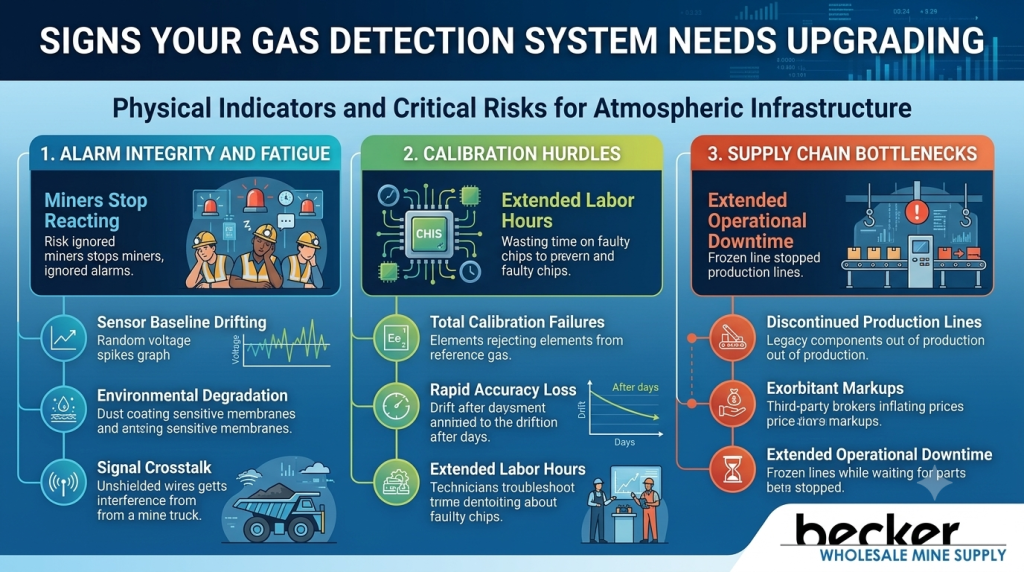
Frequent nuisance alerts, stubborn calibration failures, and scarce replacement parts mean your atmospheric infrastructure is failing. These physical indicators reveal that internal circuit boards and active sensor elements have suffered irreversible degradation. Ignoring these persistent operational warnings directly compromises your compliance standing and workforce safety.
Here is the part most operations managers will not tell you: when alarms sound constantly without an underlying hazard, miners stop reacting.
Alarm Integrity and Fatigue
- Sensor Baseline Drifting: Electrochemical cells lose internal stability over time, triggering random voltage spikes.
- Environmental Degradation: Constant exposure to heavy mine dust coats delicate protective membranes, blinding the core system.
- Signal Crosstalk: Outdated, unshielded wiring channels absorb electromagnetic interference from heavy underground machinery.
Calibration Hurdles
- Total Calibration Failures: Internal elements reject standard reference gases during routine field adjustments.
- Rapid Accuracy Loss: Freshly calibrated modules drift outside acceptable tolerances within days of deployment.
- Extended Labor Hours: Technicians spend valuable shift time troubleshooting faulty chips instead of optimizing production.
Supply Chain Bottlenecks
- Discontinued Production Lines: Original equipment manufacturers cease producing specific legacy system components entirely.
- Exorbitant Markups: Third-party brokers inflate prices on remaining refurbished electronics.
- Extended Operational Downtime: Production lines freeze while waiting weeks for secondary market circuit boards to ship.
GET IN TOUCH
In a hurry? Call us at +1-724-515-4993
Why Is Multi-Gas Monitoring Important?
Modern mining environments release complex, overlapping atmospheric hazards that a single-gas legacy device cannot effectively identify. Modern production faces release mixtures of volatile hydrocarbons and toxic engine byproducts simultaneously. Upgrading to a multi-gas platform allows a single fixed gas detector system node to analyze several atmospheric threats at once. This comprehensive approach ensures complete protection across every operational sector.
- Methane (CH_4): Combustible gas requiring constant, non-dispersive infrared tracking along active coal faces.
- Carbon Monoxide (CO): Highly toxic, odorless combustion byproduct indicating thermal tracking or deep equipment fires.
- Oxygen (O_2) Deficiency: Displaced atmospheric zones caused by nitrogen accumulation or poor ventilation layouts.
- Hydrogen Sulfide (H_2S): Deadly gas pockets trapped inside older strata formations, released during heavy blasting cycles.
- Nitrogen Dioxide (NO_2): Toxic exhaust concentrations lingering within high-traffic haulage routes.
Communication Features Are Outdated
Legacy analog monitoring systems isolate critical alarm data at the physical face, preventing rapid surface notifications. Modern operations cannot rely on local flashing strobes alone when an atmospheric emergency unfolds miles underground. Next-generation setups feed telemetry directly into existing mine communication backbones, enabling automatic ventilation changes and instant surface alerts. This connectivity speeds up emergency responses when every second counts.
- Remote Surface Telemetry: Dispatches real-time atmospheric data directly to engineering monitors above ground.
- Instant Mobile Integration: Transmits immediate alerts to safety supervisors via tablet or smartphone applications.
- Central Control Dashboards: Maps localized gas levels across the entire facility footprint from one screen.
- Automated Safety Interlocks: Triggers exhaust fans and cuts equipment power automatically when gas levels spike.
Maintenance Costs Continue to Increase
Sunk capital spent on nursing obsolete safety electronics quickly outpaces the cost of deploying a completely new monitoring network. Patchwork repairs create a false sense of security while consuming maintenance budgets through constant service calls and sensor replacements. Upgrading to modern hardware reduces labor requirements, lowers parts costs, and stabilizes long-term operational budgets.
- Escalating Service Cycles: Technicians spend more time fixing old parts than performing routine maintenance.
- Sensory Component Inflation: Replacement sensors for old models cost significantly more due to low manufacturer supply.
- Lost Production Hours: Halting work to troubleshoot old safety hardware stops extraction and drains revenue.
How Can Outdated Equipment Affect Safety Compliance?
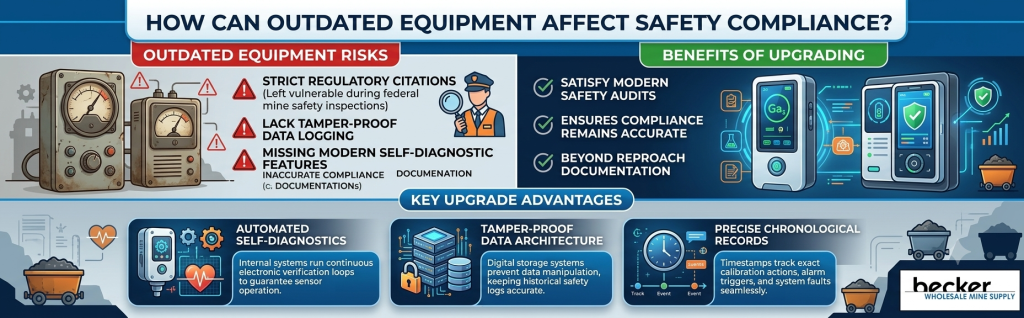
Running obsolete gas detection hardware leaves your operation vulnerable to strict regulatory citations during federal mine safety inspections. Regulatory bodies continuously update compliance baselines as safety technologies advance. Older monitoring setups often lack the tamper-proof data logging and self-diagnostic features required to satisfy modern safety audits. Upgrading ensures your compliance documentation remains accurate and beyond reproach.
- Automated Self-Diagnostics: Internal systems run continuous electronic verification loops to guarantee sensor operation.
- Tamper-Proof Data Architecture: Digital storage systems prevent data manipulation, keeping historical safety logs accurate.
- Precise Chronological Records: Timestamps track exact calibration actions, alarm triggers, and system faults seamlessly.
Slow Response During Gas Events
Old, degraded sensors delay alarm activation, cutting down the critical time your crew needs to safely evacuate. Slow sensor reactions leave miners exposed to toxic gas clouds before the system triggers a warning. Modern fixed gas detector system configurations use advanced, fast-reacting sensor arrays that register gas spikes instantly. This rapid response lets your ventilation systems engage before conditions turn fatal.
- Immediate Relay Activation: Triggers alarms the instant gas levels pass safe limits, removing mechanical delays.
- Continuous Face Transmission: Eliminates data packet drops across the internal monitoring network.
- Proactive Evacuation Windows: Gives crews extra minutes to leave the area before gases reach toxic concentrations.
Limited Data Logging
Paper-based logs and basic display panels cannot track long-term gas trends or hidden atmospheric hazards. Modern safety management requires deeper data analysis than simply checking if a display reads zero. Next-generation tracking platforms capture and store continuous exposure data, mapping gas patterns across every shift. This comprehensive data logging allows safety managers to identify ventilation dead zones before incidents occur.
- Gas Concentration Analytics: Tracks minor gas fluctuations over time to reveal hidden ventilation weaknesses.
- Comprehensive Sensor Auditing: Logs exact sensor lifespan data to make component replacement predictable.
- Detailed Event Reconstruction: Records precise gas levels step-by-step to simplify post-incident safety investigations.
GET IN TOUCH
In a hurry? Call us at +1-724-515-4993
When Should You Replace a Fixed Gas Detector System?
Your monitoring network must be upgraded whenever mine expansions or altered ventilation paths change your facility’s layout. Safety needs shift fast as underground workings push into new territory or surface footprints grow. Old monitoring systems cannot easily expand to cover these new areas, leaving fresh production faces unprotected. Updating your hardware keeps your safety setup aligned with your current production scale.
- Expanded Work Areas: Extending infrastructure requires adding new sensor nodes without losing signal strength.
- Altered Ventilation Paths: Changing your air routing means relocating fixed gas detector system nodes to match updated flow directions.
- New Equipment Additions: Deploying high-output diesel machinery requires closer tracking of exhaust gases like NO_2 and CO.
Homeowner-Focused Safety Partnerships
Becker Wholesale Mine Supply delivers field-tested atmospheric safety systems built to survive the harshest extraction environments. We look past generic product catalogs to engineer rugged safety solutions tailored to your specific mine layout and local regulations. Our technical teams provide complete support from initial design through field installation and long-term calibration. Partnering with Becker keeps your workforce safe and your operations fully compliant.
- Custom Engineering Analysis: Designs system layouts tailored to your mine’s unique structural challenges and airflow.
- Comprehensive System Field Training: Trains your maintenance teams on fast, accurate system calibration and diagnostics.
- Reliable Component Delivery: Ships critical replacement sensors and modules fast to eliminate safety downtime.
Securing Your Workplace Safety Infrastructure
The real test of an underground safety setup happens when conditions decline. Relying on an outdated fixed gas detector system leaves your workforce unprotected against sudden gas outbursts and risks costly regulatory shutdowns. Upgrading your monitoring setup removes these systemic vulnerabilities, protects your crew, and keeps production running smoothly.
Becker Wholesale Mine Supply builds durable, high-performance safety networks tailored for American mining operations. Our technical specialists are ready to evaluate your current monitoring setup and design an upgraded system that fits your operational needs. Call Becker Wholesale Mine Supply today to secure your mine’s safety infrastructure.
Frequently Asked Questions
Q: What is the typical operational lifespan of a heavy-duty mine gas monitor?
A: While core transmitter units can function for up to a decade with excellent care, the active electrochemical and catalytic sensors require replacement every two to three years due to environmental wear.
Q: Which atmospheric gases must be tracked inside underground operations?
A: A compliant fixed gas detector system must monitor methane (CH_4) for fire prevention, carbon monoxide (CO) and nitrogen dioxide (NO_2) for engine exhaust safety, and oxygen (O_2) levels to prevent suffocation.
Q: How often do modern fixed atmospheric monitors require field calibration?
A: Standard regulations require full calibration adjustments every 30 to 90 days, depending on environmental severity, paired with regular function checks between cycles to verify sensor accuracy.
Q: Can next-generation gas tracking setups connect with our current mine communication network?
A: Yes, modern systems feature flexible digital outputs that integrate smoothly with existing fiber optic, Ethernet, or wireless mine networks to stream live data directly to surface control rooms.
Q: Why should our operation choose Becker Wholesale Mine Supply for safety upgrades?
A: Becker Wholesale Mine Supply provides heavy-duty, field-proven equipment backed by deep mining industry expertise, offering complete installation layout design and reliable technical support nationwide.
Products That We Offer
- VHF Leaky Feeder System
- UHF Leaky Feeder System
- SMARTSENSE®FIXED MONITOR
- RNG-500VHF Leaky Feeder Cable
- UHF Low Loss Leaky Feeder Cable
- Kenwood NX-203/303 Radios
Take control of your mining communication systems today! With Becker Wholesale Mine Supply, the leading manufacturer in the USA. Contact us now and revolutionize your mining communication systems!