How Leaky Feeder Radio Enhances Mine’s Worker Connectivity
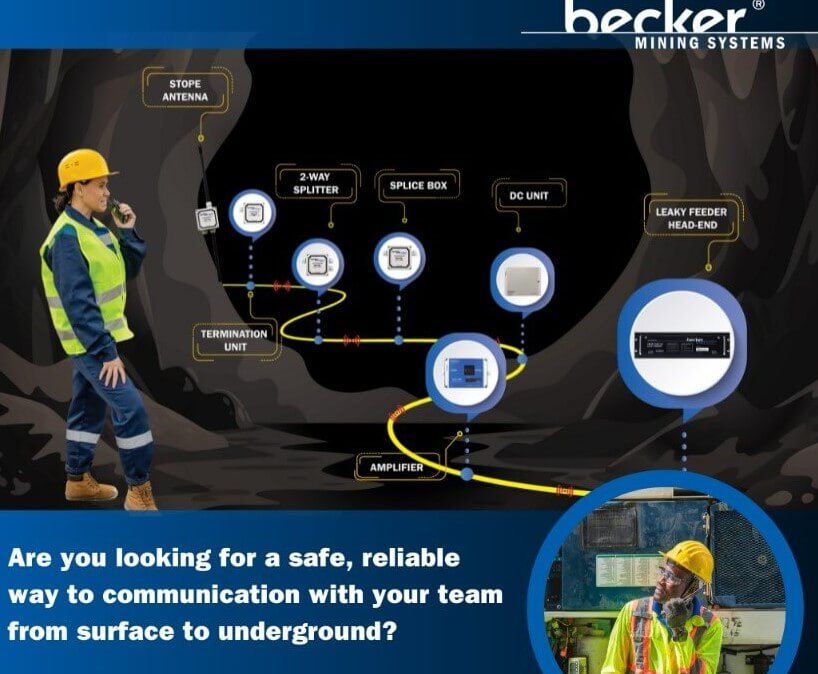
Underground mining operations collapse into chaos without clear, reliable communication lines. When the subterranean landscape swallows your signal, safety risks skyrocket and productivity drops instantly. One of the most dependable lifelines used today is the leaky feeder radio system, which maintains continuous communication even in deep, suffocating tunnels where standard wireless signals fail completely. Modern deployments are engineered directly alongside broader electrical systems for mining to guarantee communication networks remain stable, powered, and tightly integrated with other underground infrastructure. For industry leaders like Becker Wholesale Mine Supply, this specific communication technology is not an administrative luxury; it is a core pillar of building safer, high-yield mining environments across the USA. Their focus centers on delivering rugged infrastructure that keeps miners connected in severe conditions where traditional wireless tools die on arrival.
Key Takeaways
- Continuous Subterranean Coverage: Leaky feeder radio networks deliver unbroken underground communication through thick rock where normal signals fail.
- Severe Environment Deployment: These systems are widely utilized across deep-shaft mines, transit tunnels, and tightly enclosed industrial spaces.
- Instantaneous Risk Reduction: Safety protocols improve via real-time, low-latency communication between underground workers and surface control rooms.
- Scalable Infrastructure: Coaxial network footprints expand easily, splicing new segments as active mining operations grow.
- Unified Power Integration: Coupling these networks with electrical systems for mining prevents signal drops and maintains total operational stability.
- End-to-End Field Support: National suppliers like Becker Wholesale Mine Supply manage full system design, hardware sourcing, and deployment.
What Is a Leaky Feeder Radio System?
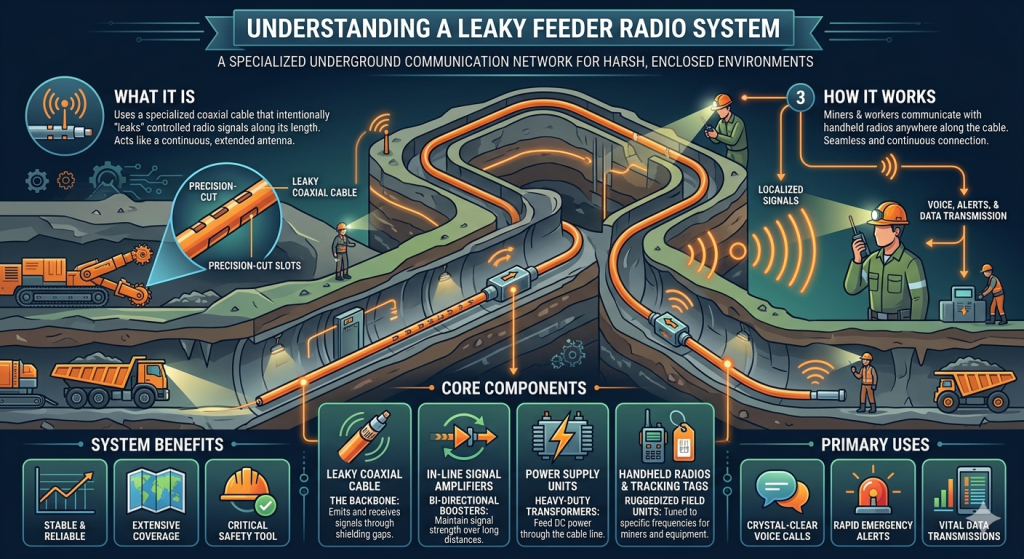
A leaky feeder radio system is a specialized underground communication network built specifically for harsh, enclosed environments where radio waves cannot travel freely through the air. Instead of relying on traditional open-air line-of-sight transmission, the system uses a high-grade coaxial cable that intentionally emits small, controlled radio signals through gaps in its shielding along its entire length.
Think of this cable as an endless, stretched-out antenna snaking through kilometers of dark headings. As miners navigate through deep shafts and active faces, their handheld two-way radios pick up this localized signal, keeping them connected without a second of interruption.
The core physical components typically include:
- Leaky Coaxial Cable: The backbone wire featuring precision-cut slots to allow signal leakage.
- In-Line Signal Amplifiers: Bi-directional boosters placed at calculated intervals to fight signal attenuation.
- Power Supply Units: Heavy-duty transformers feeding direct current through the cable line.
- Handheld Radios & Tracking Tags: Ruggedized field units tuned to the specific frequency of the feeder line.
This industrial setup creates a continuous, highly stable communication loop. It easily supports crystal-clear voice calls, rapid emergency alerts, and vital low-bandwidth data transmissions across the entire operation.
GET IN TOUCH
In a hurry? Call us at +1-724-515-4993
How Does a Leaky Feeder Radio System Improve Underground Connectivity?
Underground environments present brutal physical hurdles: dense mineralized rock layers, high humidity, massive steel structures, and constantly shifting geographic layouts. All of these elements actively scramble or block traditional wireless networks. A leaky feeder setup bypasses these barriers entirely by physically running the transmission medium directly through the active mine shafts. As the radio frequency signals travel down the cable, they emit small, measured amounts of energy, creating a reliable wireless coverage envelope a few hundred feet around the wire at any given point.
This physical layout delivers three major advantages:
- Impenetrable Signal Stability: Provides unwavering voice and data links deep within the earth’s crust.
- Negligible Signal Degradation: Overcomes the dampening effects of jagged rock walls over massive distances.
- Rapid Physical Scalability: Adapts to modern mine development by allowing engineers to splice in more cable as new tunnels are blasted out.
During the initial design phases, project engineers coordinate these communication runs directly with the mine’s main electrical systems for mining. This ensures line amplifiers receive clean, unfluctuating power, avoiding signal dropouts when heavy machinery cycles on. The result is a hardened communication backbone that remains completely dependable, even when navigating the most labyrinthine underground layouts.
Why Is Communication Critical in Underground Mining Operations?
Reliable communication in deep-earth extraction is not about administrative convenience—it is a life-or-death operational necessity. Workers routinely operate in isolated, high-risk zones, meaning any delay in communication can escalate a minor operational hitch into a major catastrophe.
Immediate safety benefits include:
- Instant Hazard Dispatches: Real-time reporting of volatile atmospheric shifts, methane gas pockets, or structural shifts.
- Accelerated Rescue Coordination: Direct, uninhibited lines to first responders if an extraction face suffers a localized collapse.
- Rapid Mechanical Reporting: Instant notification to the surface when critical haulage or ventilation equipment fails.
- Synchronized Team Command: Tight, seamless loops connecting the surface superintendent with the drillers down in the hole.
From a production standpoint, maintaining a constant link slashes costly downtime. Supervisors can adjust hauling routes instantly, while underground maintenance teams can diagnose and troubleshoot haul-truck failures the second they happen. In modern, high-tonnage mines, these communication grids are hardwired directly into the facility’s electrical systems for mining, ensuring power distribution loops and emergency lifelines support each other perfectly.
How Does Becker Wholesale Mine Supply Support Mining Communication Systems?
Becker Wholesale Mine Supply serves as a crucial partner in engineering, supplying, and optimizing rugged communication infrastructure for complex mining operations across North America.
Their field-level support typically includes:
- Custom Network Mapping: Designing cable layouts tailored to the unique physical geology and depth of the mine.
- Amplifier Placement Calibration: Calculating precise distances for line boosters to prevent signal drops over miles of wire.
- Safety System Integration: Interfacing the radio network with existing personnel tracking and environmental monitoring software.
- On-Site Field Optimization: Providing ongoing technical troubleshooting, component replacement, and system tuning under actual working conditions.
Rather than just dropping hardware at the surface portal, they focus on building complete, field-tested communication ecosystems. This ensures your leaky feeder system survives the relentless physical punishment of heavy vibration, corrosive moisture, and continuous tunnel expansion. Their long-term field experience also helps operators cleanly align their communication networks with the mine’s overarching electrical systems for mining, boosting overall system resilience and maximizing uptime.
How Are Leaky Feeder Radios Integrated With Mining Safety and Operations?
Modern underground operations no longer treat communication networks as isolated systems. Today, leaky feeder cables act as the multi-channel highway for an array of sophisticated safety and telemetry tools, turning a basic voice line into a fully integrated operational nervous system.
Safety Monitoring & Personnel Tracking
The system continuously tracks personnel and equipment location via RFID tags, giving surface dispatchers a real-time headcount of exactly who is in every drift. If an atmospheric hazard arises, evacuation commands can be targeted to specific zones instantly.
Automation & Technical Telemetry
Environmental sensors use the leaky feeder network to stream live data regarding gas concentrations, ambient temperatures, and airflow levels back to command centers. Built-in machinery diagnostics track haul-truck metrics to flag issues before a motor blows.
This highly interconnected environment allows mine managers to make rapid, data-backed decisions. It streamlines shift changes, sharpens evacuation drills, and refines preventative maintenance schedules. When tied directly into the facility’s electrical systems for mining, the entire underground infrastructure becomes a synchronized, dependable asset.
GET IN TOUCH
In a hurry? Call us at +1-724-515-4993
Comparative Analysis: Communication Infrastructure Performance
| Performance Metric | Leaky Feeder Cable Network | Standard Open-Air Industrial Wi-Fi |
| Signal Penetration | Exceptional: Follows the tunnel geometry precisely through solid rock. | Poor: Blind spots occur the moment the line-of-sight is broken by a bend. |
| Expansion Complexity | Low: Involves splicing on more coaxial cable and inline amplifiers as the drift grows. | High: Requires complex network configurations and multiple wireless access points. |
| Environmental Durability | High: Built with heavy shielding to resist moisture, rockfall dust, and vibration. | Moderate: Sensitive electronic access points are vulnerable to harsh subterranean moisture. |
| Power Infrastructure Dependency | Integrated: Draws continuous low-voltage DC power straight through the communication line. | Fragmented: Demands dedicated local AC power drops for every single routing node. |
Multi-Layered Entity Reference Guide
- Leaky Coaxial Cable: A specialized copper or aluminum cable with intentional openings in its outer conductor, allowing RF signals to transmit and receive along its entire span.
- Bi-Directional Amplifier (BDA): An inline electronic booster component that simultaneously strengthens both upstream signals to the surface and downstream signals to the miners.
- Radio Frequency Attenuation: The natural loss of signal strength that occurs as electromagnetic waves travel through cables or physical barriers like rock.
- Mine Safety and Health Administration (MSHA): The federal regulatory body that sets strict safety and operational standards for all underground communications and electronics.
- Intrinsically Safe Electronics: Equipment engineered to operate below specific thermal and electrical energy thresholds, entirely eliminating the risk of sparking an atmospheric explosion.
Real-World Field Insight
A Note on Real-World Subterranean Conditions:
Out in the drifts, the biggest threat to your radio network isn’t software—it’s water and rock movement. Mine managers often make the mistake of mounting leaky feeder lines too close to high-voltage power lines. This creates massive electromagnetic interference that ruins voice clarity. Always maintain the specified clearance from main power lines, and use heavy-duty, water-tight splicing kits. A single poorly sealed connection can fill with mine water, ground out your amplifiers, and take down communication across an entire section of your operation.
Mastering the Future of Subterranean Connectivity
Leaky feeder radio networks have earned their spot as the absolute backbone of modern underground mining communication. By transforming an ordinary coaxial wire into a continuous, tunnel-spanning antenna, they solve the most stubborn obstacle in the business: catastrophic signal drop-off in deep, winding environments.
When these communication lines are deployed correctly alongside heavy-duty electrical systems for mining, they form a rock-solid foundation for safer operations, faster emergency responses, and efficient daily workflows. Companies like Becker Wholesale Mine Supply remain indispensable allies, helping operators navigate the engineering realities of designing and deploying these rugged systems. As operations push deeper and layouts grow more complex, keeping your crews connected isn’t just an asset—it’s your ultimate insurance policy.
Ready to bulletproof your underground communications? Call Becker Wholesale Mine Supply to speak with an application engineer about tailoring a ruggedized leaky feeder system for your specific layout today.
Frequently Asked Questions
Q: What is a leaky feeder radio system used for in mining?
A: It is used to maintain unbroken, two-way voice and data communication throughout deep underground mines. Because solid rock and dense ore bodies completely block conventional wireless signals, this specialized network uses a slotted coaxial cable to act as a continuous antenna, distributing clear radio coverage directly along the entire path of the underground tunnels.
Q: How far can a leaky feeder system cover?
A: A properly engineered system can span dozens of kilometers across complex tunnel networks. While standard radio signals degrade within a few hundred feet of a tunnel bend, a leaky feeder network uses inline bi-directional amplifiers to boost signal strength at regular intervals, allowing the coverage wire to extend indefinitely as new shafts are carved out.
Q: Is leaky feeder communication reliable in emergencies?
A: Yes, it is considered the gold standard for emergency underground communication. Because the physical cable is highly ruggedized and integrated with back-up power sources, the network remains operational during major power outages or structural emergencies, providing a vital lifeline between trapped personnel and surface rescue teams.
Q: Can leaky feeder systems support data transmission?
A: Yes, modern leaky feeder installations handle both voice calls and critical operational data. Beyond standard two-way radio traffic, the electronic infrastructure supports real-time personnel tracking, equipment telemetry, remote gas detection readouts, and automated control signals for underground machinery.
Q: Why is integration with electrical infrastructure important?
A: Proper integration prevents dangerous signal drops and protects the communication line from severe electromagnetic interference. Splicing a communication network alongside heavy electrical systems for mining ensures that amplifiers receive a continuous, clean power supply, preventing system-wide communication blackouts when massive mining equipment spikes the grid.
Q: Who provides leaky feeder system solutions in the USA?
A: Becker Wholesale Mine Supply is a premier provider of underground communication systems and components within the United States. They specialize in the end-to-end design, hardware distribution, and technical optimization of ruggedized leaky feeder systems, ensuring complete compliance with federal mining safety regulations.
Products That We Offer
- VHF Leaky Feeder System
- UHF Leaky Feeder System
- SMARTSENSE®FIXED MONITOR
- RNG-500VHF Leaky Feeder Cable
- UHF Low Loss Leaky Feeder Cable
- Kenwood NX-203/303 Radios
Take control of your mining communication systems today! With Becker Wholesale Mine Supply, the leading manufacturer in the USA. Contact us now and revolutionize your mining communication systems!