Bump Testing Gas Detector: How Often Mine Safety Teams Should Test

For portable gas detectors, a practical baseline is to perform a bump test before each day’s use, following the detector manufacturer’s instructions. This quick function check confirms that test gas reaches the sensors and that the alarms respond. It does not confirm that the displayed readings are accurate, and it does not replace a required calibration.
When you bump test a gas detector, use the correct test gas, adapter, tubing, and procedure for that model. Mine rules, the detector manual, and your site safety plan may call for additional checks or a different schedule. Your written procedure should state who performs the test, what counts as a pass, and what happens if a detector fails.
Key Takeaways
- Test portable gas detectors before each day’s use as a general best practice, unless applicable rules or the manufacturer require a stricter schedule.
- A bump test checks sensor response and alarms; it does not prove measurement accuracy.
- A failed bump test means the detector should not go into service until it passes the required follow-up procedure.
- Keep bump-test records separate from calibration records so a function check is not mistaken for a calibration.
- Mine-specific rules may set their own calibration requirements. A calibration interval is not automatically a bump-test interval.
What Does A Gas Detector Bump Test Check?
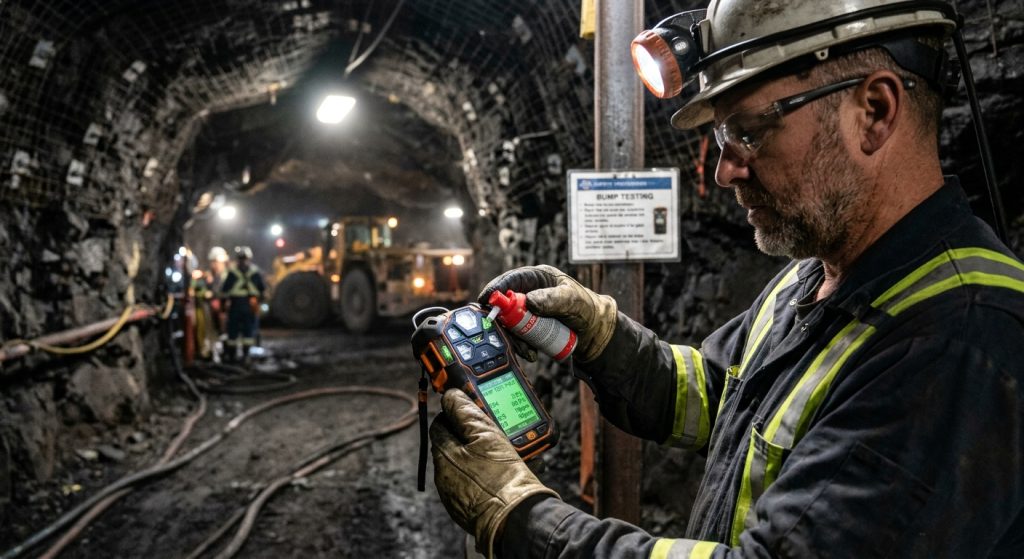
A bump test briefly exposes a detector’s sensors to a known test gas concentration to confirm that gas reaches the sensors and triggers the expected alarms. It is a functional check of the instrument’s response path, sensors, and alarm functions.
A successful bump test does not tell you whether the detector’s reading is within the manufacturer’s accuracy tolerance. OSHA guidance distinguishes a bump test from a calibration check and full calibration: a calibration check compares the reading with the known test-gas concentration, while a full calibration adjusts the instrument when needed.
This distinction matters in a mine. A detector can alarm during a bump test and still need calibration if it is reading inaccurately. Staff should not treat “the alarm sounded” as proof that the instrument is ready for every monitoring task.
GET IN TOUCH
In a hurry? Call us at +1-724-515-4993
How Often Should Mine Safety Teams Bump Test Gas Detectors?
For portable direct-reading gas monitors, OSHA-hosted guidance refers to the ISEA recommendation to perform a bump test or calibration check before each day’s use, in line with the manufacturer’s instructions. That is a sound starting point for a mine’s written procedure.
The exact routine still depends on how the detector is used. A team may require testing at the start of each shift, before a detector is handed to another worker, or before a specific task if the site procedure or manufacturer calls for it. A detector that stays in service across shifts should follow a schedule that accounts for each user and work period. Do not assume a previous worker’s test covers a later shift unless your procedure explicitly says so and the instrument’s use conditions support it.
| Situation | Practical schedule point |
| Portable detector used during the workday | Bump test before the day’s use, following the manual and mine procedure. |
| Detector shared between workers or shifts | Define responsibility for each handoff; test again when required by the site procedure or manufacturer. |
| Detector fails a bump test | Keep it out of service and follow the manufacturer’s calibration or repair steps before use. |
| Scheduled calibration | Follow the detector manual and the requirements for that specific detector and application. |
| Fixed or machine-mounted monitor | Use its own prescribed inspection and calibration procedure; portable-monitor guidance may not apply. |
Don’t Confuse A Bump-Test Schedule With A Calibration Requirement
Mine regulations can set calibration requirements for specific detectors and uses. For example, 30 CFR § 75.320 says certain MSHA-approved methane detectors used for tests must be calibrated with a known methane-air mixture at least once every 31 days. It also says oxygen detectors used for specified oxygen-deficiency tests must be calibrated at the start of each shift in which they are used. Those are calibration requirements under a particular rule; they do not create one universal bump-test interval for every detector in every mine
Before setting a fleet-wide schedule, identify each device’s model, gases measured, location or assigned user, and intended role. Then check the applicable mine regulations, approval conditions, manufacturer instructions, and site-specific procedures. Portable, fixed, machine-mounted, and atmospheric monitoring systems may have different requirements.
Our related guide, Gas Detector Calibration Intervals: What Mine Safety Teams Should Plan, explains how to separate routine function checks from scheduled calibration planning.
A Practical Pre-Use Bump-Test Routine
The detector manual should control the exact steps. As a planning framework, a pre-use routine can include:
- Inspect the detector. Check the housing, display, battery, sensor openings, filters, and accessories for visible damage or blockage.
- Confirm the setup. Verify that the test gas matches the sensors and concentration required for the detector. Use the specified regulator, tubing, and adapter.
- Run the bump test. Apply the gas for the time and in the manner stated by the manufacturer or the approved test station.
- Check the response. Confirm that the expected sensors respond and that audible, visual, and vibration alarms function as configured.
- Record the outcome. Log the detector ID, date and time, person performing the test, gas used, result, and any follow-up action.
Use certified test gas that is within its expiration date. Incorrect gas, an incompatible adapter, or expired gas can produce a misleading result. OSHA also advises following manufacturer guidance for test equipment and calibration procedures.
What Should You Do If A Detector Fails?
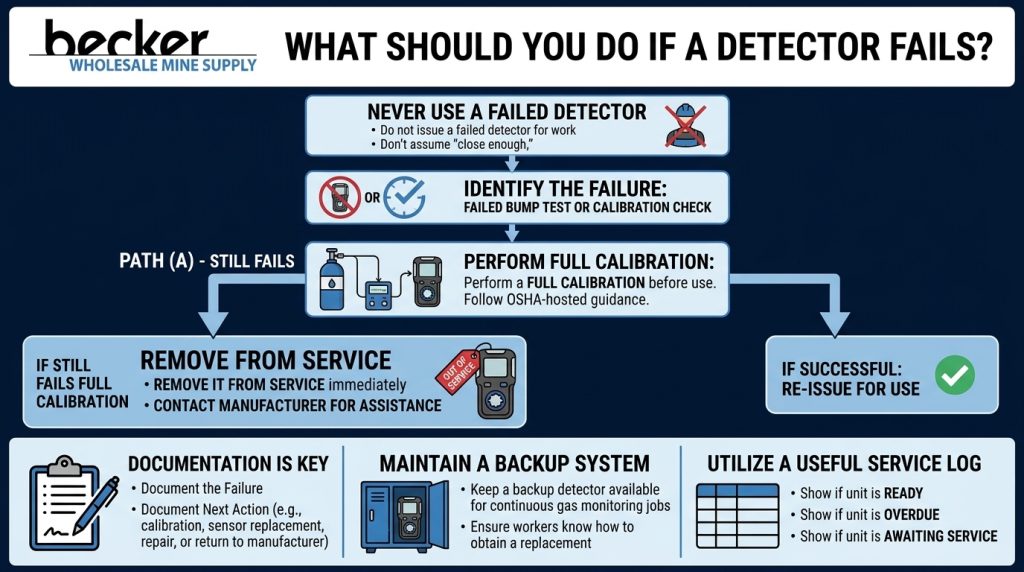
Do not issue a failed detector for work based on the assumption that it will be “close enough.” Follow the manual and site procedure. OSHA-hosted guidance says a failed bump test or calibration check should be followed by a full calibration before use. If the instrument still fails full calibration, remove it from service and contact the manufacturer for assistance.
Document the failure and the next action, such as calibration, sensor replacement, repair, or return to the manufacturer. Keep a backup detector available where the job requires continuous gas monitoring, and make sure workers know how to obtain a replacement. A test log is most useful when it shows whether a unit is ready, overdue, or awaiting service.
GET IN TOUCH
In a hurry? Call us at +1-724-515-4993
Make The Testing Schedule Workable Underground
A schedule only helps if workers can follow it at the point of use. Assign a clear owner for test-gas inventory, detector checks, calibration due dates, and records. Keep the correct gas and adapters near the charging or issue station, and train each user to recognize a failed alarm check and take the detector out of service.
Review the schedule when the mine changes the detector model, sensor type, gas being monitored, work area, or manufacturer’s instructions. Repeated failures or calibration drift may signal a problem with the sensor, test setup, or operating conditions. Treat those patterns as a reason to review the program, not simply as paperwork to close out.
Becker Wholesale Mine Supply provides gas monitoring devices for mining applications. Our team can discuss gas detection equipment and support for your monitoring setup. Contact us to talk through the detectors used at your operation.
Frequently Asked Questions
Q: Should a gas detector be bump tested every day?
For portable direct-reading gas monitors, OSHA-hosted guidance references testing before each day’s use, following the manufacturer’s instructions. A mine’s regulations or written procedure may require additional checks.
Q: Does a bump test calibrate a detector?
No. A bump test checks whether the detector responds to gas and activates its alarms. Calibration checks or adjusts the accuracy of its readings.
Q: Should a detector be used if it fails a bump test?
No. Remove it from service and follow the manufacturer’s procedure for calibration or repair. Return it to use only when it meets the required pass criteria.
Q: Do fixed gas monitors need the same bump-test schedule as portable detectors?
Not necessarily. Fixed and machine-mounted systems can have different procedures and requirements. Use the instructions and rules that apply to the exact equipment and application.
Q: How should mine teams document bump tests?
Record the detector identifier, date and time, test gas, test result, operator, and any corrective action. Keep these records distinct from calibration records.
Products That We Offer
- VHF Leaky Feeder System
- UHF Leaky Feeder System
- SMARTSENSE®FIXED MONITOR
- RNG-500VHF Leaky Feeder Cable
- UHF Low Loss Leaky Feeder Cable
- Kenwood NX-203/303 Radios
Take control of your mining communication systems today! With Becker Wholesale Mine Supply, the leading manufacturer in the USA. Contact us now and revolutionize your mining communication systems!