Gas Leakage Sensors and Emergency Response in Mining

A gas alarm only matters if the miners and supervisors understand what is happening when it goes off and how to react. Gas leakage sensors may help identify dangerous situations in a mine, but a safe reaction depends on effective alarm systems, reliable communication methods, knowledgeable decision-makers, and an emergency response plan designed specifically for the mine.
Methane is a fire hazard and may build-up when there is poor ventilation. Since carbon monoxide and other hazardous gases pose unique risks, any gas detection system should be designed to reflect the type of gas(es) being used in the specific operational environment. Additionally, NIOSH states that factors such as the presence of dust, moisture, air flow patterns, and the response time of sensors will determine how effective a gas detection system is at detecting methane in close proximity to work zones.
At Becker Wholesale Mine Supply, we provide gas monitoring alongside communication, tracking, and other mining technologies. Our SmartSense Fixed Monitor SSFM-100 can support up to four integrated gas sensors and stores calibration records, alarm history, and data logs. The right configuration depends on the mine, the gases being monitored, and the operator’s safety plan.
Key Takeaways
- Gas leakage sensors give crews information about hazardous atmospheres; they do not replace ventilation, training, or an emergency response plan.
- Sensor placement and selection should reflect the gas, work area, airflow, and operating conditions.
- An alarm must reach the people who need to act, through clear local signals and a dependable communication process.
- Calibration, testing, maintenance, and alarm records help operators assess whether a monitoring system is ready to perform.
- Evacuation decisions and routes should follow the mine’s approved, site-specific procedures.
What Gas Leakage Sensors Do In A Mine
Gas leakage sensors measure a target gas in the surrounding atmosphere and report when a set level is reached. Depending on the equipment and application, a mine may use fixed sensors, machine-mounted monitors, or portable detectors. Those devices serve different purposes: a fixed system can monitor a defined area continuously, while portable equipment lets trained personnel check conditions in specific locations.
A monitoring plan should start with the hazards. Methane, carbon monoxide, oxygen, and other gases have different properties and require suitable sensors. A detector configured for one gas should not be assumed to detect another. Becker’s fixed monitor product information lists supported gas ranges and options, but the appropriate sensor combination and alarm settings need to be selected for the operation.
A sensor reading is only useful if it represents the atmosphere miners may encounter. For example, U.S. rules for underground coal mines specify requirements for atmospheric monitoring sensors and methane monitors, including where certain sensors must be installed. These provisions apply to particular mine types and circumstances; mine operators should follow the requirements and plans that apply to their operation.
Why Sensor Placement And Upkeep Matter
Sensor location affects what a system can detect. Air moves through mine workings in patterns shaped by ventilation, equipment, and the layout of the work area. A sensor placed where the target gas is unlikely to reach it may not provide a useful warning. NIOSH research on methane monitoring highlights the importance of placement near the working face and of understanding airflow around mining equipment.
The harsh conditions underground also affect equipment. Dust or water can interfere with sensor performance, and sensors need to be tested and maintained according to the manufacturer’s instructions and applicable mine requirements. For underground coal mine methane monitors, federal rules require calibration at least once every 31 days by properly trained personnel, with records kept. Requirements vary by equipment and mine type, so operators should verify the rules that apply to their systems.
A practical monitoring program should define who checks the equipment, how alarms are tested, how faults are reported, and where records are stored. Those records can help teams spot recurring issues, confirm maintenance, and review system performance after an alarm or incident.
GET IN TOUCH
In a hurry? Call us at +1-724-515-4993
Connect Detection To Communication
Detection is one part of the response chain. If an alarm occurs, the responsible people must know where it came from, who may be affected, and how to contact them. A monitoring setup should make alarm signals noticeable to the intended workers and supervisors, and the mine’s communication process should account for areas where ordinary radio or voice communication may be difficult.
For underground coal atmospheric monitoring systems, federal rules specify visual and audible signals at designated locations when certain alert or alarm levels are reached, as well as indications of sensor status. These are requirements for the systems covered by those regulations, not a universal design prescription for every mine.
Communication and tracking systems can help a response team understand where personnel are and relay instructions. Becker WMS supplies mining communication, tracking, and gas monitoring technologies. A mine should evaluate how these systems fit together with its monitoring equipment, emergency procedures, and required approvals.
What Should Happen When A Gas Alarm Sounds?
The correct action depends on the mine’s emergency response plan, the type of alarm, and the conditions underground. Miners should follow their training and the site’s approved procedures. They should not ignore an alarm, assume it is a false reading, or improvise a response that conflicts with mine instructions.
An effective response plan identifies who is in charge for the shift, how miners are notified, how workers are accounted for, and which routes or designated areas are used. MSHA’s emergency response training guidance covers evacuation, communications, mine monitoring, escapeways, and coordination with emergency personnel. For underground coal mines, MSHA regulations also require immediate evacuation when a mine emergency presents an imminent danger from fire, explosion, or gas or water inundation.
The plan should make responsibilities clear before an alarm occurs:
- Recognize and report the alarm. Miners should know the signals used at their location and who to notify.
- Follow the mine’s instructions. Use the designated evacuation or response procedure for that alarm and area.
- Account for personnel. Supervisors and responsible personnel need a way to track who has reached safety and who may still be underground.
- Keep untrained personnel out of hazardous areas. Emergency response and re-entry should be handled by people authorized and equipped under the site plan.
- Review the event. Record the alarm, check system status, and investigate through the mine’s established procedures before returning the area to normal operation.
This sequence is a general explanation, not a substitute for the mine’s emergency response plan or required training. Evacuation routes, self-rescue equipment, communication methods, and re-entry decisions must be determined by the operator’s site-specific procedures and applicable regulations.
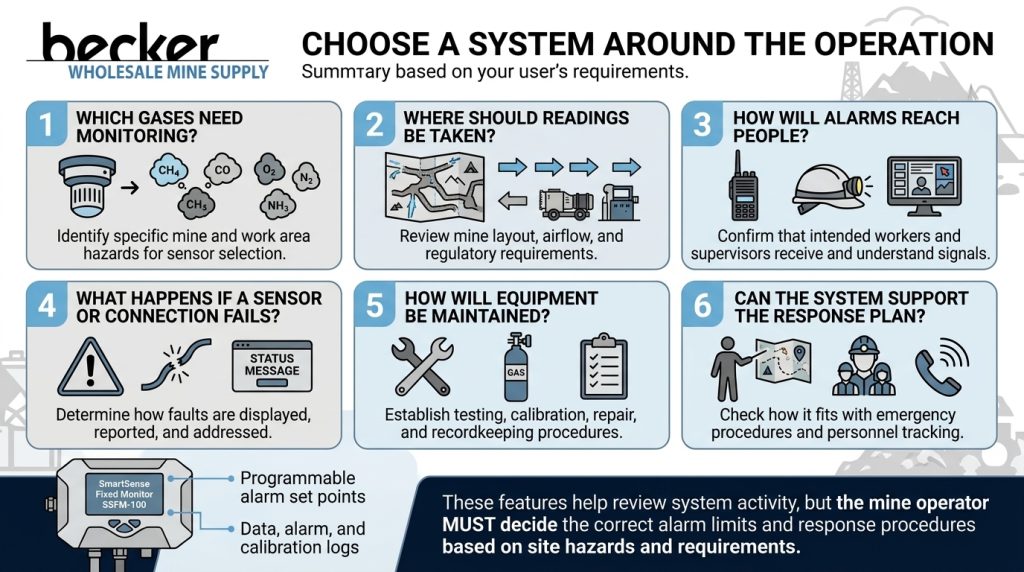
Choose A System Around The Operation
When evaluating gas leakage sensors for mining, consider more than the detector itself:
- Which gases need monitoring? Base sensor selection on the hazards identified for the mine and work area.
- Where should readings be taken? Review the mine layout, airflow, equipment, and relevant regulatory requirements.
- How will alarms reach people? Confirm that the intended workers and supervisors can receive and understand the signals.
- What happens if a sensor or connection fails? Determine how a fault is displayed, reported, and addressed.
- How will the equipment be maintained? Establish testing, calibration, repair, and recordkeeping procedures.
- Can the system support the response plan? Check how it fits with communications, personnel tracking, and emergency procedures.
Becker WMS’s SmartSense Fixed Monitor SSFM-100 includes programmable alarm set points and logs for calibration records, alarm history, and data. These features may help operators review system activity, but they do not establish the correct alarm limits or response procedures for a particular site. Those decisions belong to the mine operator, based on the system, the hazards, and applicable requirements.
GET IN TOUCH
In a hurry? Call us at +1-724-515-4993
Build Readiness Before An Emergency
A gas monitoring system is most useful when miners have practiced what to do with its alarms. Training should cover the site’s signals, notification process, assigned responsibilities, and evacuation procedures. Drills can help teams identify unclear instructions, communication gaps, or routes that need attention.
For underground metal and nonmetal mines, federal rules require evacuation drills at least every six months and specify participation and evacuation requirements. Operators should check the current rules and their approved plans for the requirements that apply to their mine.
Gas leakage sensors can provide an early warning, but their value depends on the full safety system around them: suitable equipment, representative placement, reliable communications, upkeep, and practiced response procedures. Becker Wholesale Mine Supply works with mining operations on gas monitoring and communication technologies. Contact our team to discuss equipment options for your application.
Frequently Asked Questions
Q: What gases can mining sensors detect?
A: That depends on the sensor configuration. Mining systems may be designed to monitor gases such as methane, carbon monoxide, oxygen, hydrogen sulfide, and others. Operators should match each sensor to the hazards and monitoring needs of the site. Becker’s SmartSense Fixed Monitor product page lists supported gas ranges and available options.
Q: Can a gas sensor prevent a mine emergency?
A: A sensor can warn of a hazardous condition, but it cannot prevent every emergency. Safe operations also depend on controls such as ventilation, compliant equipment, maintenance, training, communication, and a site-specific response plan.
Q: Should workers re-enter after an alarm clears?
A: Workers should follow the mine’s procedures and instructions from authorized personnel. A cleared alarm by itself should not be treated as permission to re-enter; the condition and equipment need to be assessed under the mine’s established process.
Q: How often should mine gas sensors be calibrated?
A: The interval depends on the detector, its manufacturer’s instructions, the mine type, and applicable rules. For example, U.S. regulations require covered underground coal mine methane monitors to be calibrated at least once every 31 days. Operators should verify requirements for each device and application.